The Silk Roads: How Trade Carried More Than Goods
The Silk Roads were a changing network of land and sea routes. Their significance lies in the movement of knowledge as well as merchandise.
Estimated CEFR reading level: C1. Qualified claims, abstract vocabulary and sustained reasoning about networks, evidence and cultural exchange. This is an editorial estimate, not an official certification.
Five useful words
British English pronunciation (IPA). Audio uses an available English voice on your device.
merchandise /ˈmɜːtʃəndaɪs/
nounGoods intended for sale.
The caravan carried merchandise.
succession /səkˈseʃən/
nounA sequence of people or things following one another.
Goods passed through a succession of traders.
infrastructure /ˈɪnfrəˌstrʌktʃə/
nounThe basic facilities supporting an activity.
Water supplies formed essential infrastructure.
caravanserai /ˌkærəˈvænsəraɪ/
nounAn inn serving travelling merchants and their animals.
The merchants rested at a caravanserai.
distort /dɪˈstɔːt/
verbTo present something in a misleading way.
A simple label can distort a complex history.
The story
Why speak of roads in the plural?
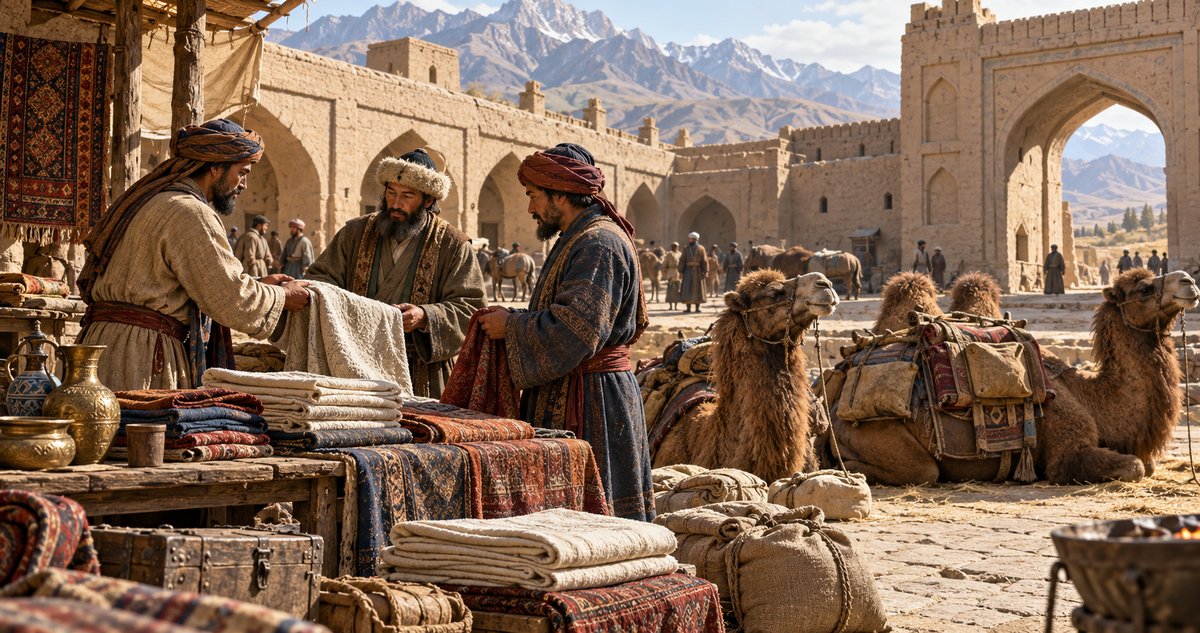
The Silk Roads were neither a single highway nor a project completed on one date. They developed from overlapping connections between communities across Eurasia, with sea routes forming another important part of the network. Long-distance exchange expanded substantially by the second century BCE, although some routes were much older.
The familiar name can distort this history. Silk was valuable, but traders also moved food, textiles, tools and other goods. Nor did every merchant travel from China to the Mediterranean. Cargo could pass through a succession of traders, each familiar with particular markets and stretches of the journey.
The work behind the journey
UNESCO describes the Chang'an-Tianshan corridor as one section of this wider network. Its surviving settlements, paths and religious buildings offer evidence of trade across difficult terrain. Mountains and deserts were obstacles, while water supplies and places to rest helped make movement possible. The infrastructure mattered as much as the willingness to travel.
A caravanserai was an inn where travelling merchants could stop with their animals and goods. Such places offered opportunities to trade and meet other travellers. They help explain how distant connections depended on local support. The romantic image of a solitary traveller crossing an empty continent leaves that support out of the picture.
What else travelled?
Movement also carried beliefs, languages and technical knowledge. UNESCO identifies the spread of papermaking and printing techniques among the exchanges associated with these routes. Religious buildings along the Tianshan corridor record the presence and movement of different traditions. Trade therefore provides part of the explanation for cultural change, without accounting for every change by itself.
Archaeological evidence can reveal connections without showing every step in a journey. An object found far from its place of production may demonstrate exchange, but cargo could have changed hands among several traders. Similar buildings can also suggest shared influences without proving that their builders travelled along the same route. These limits help researchers distinguish evidence of contact from a complete account of movement.
The network changed as geography, politics and economic needs altered the connections between communities. Travellers relied on those communities for supplies, accommodation and trade. Looking beyond a solitary merchant's journey therefore gives a fuller picture of the Silk Roads: distant exchange depended on many local relationships that could develop, weaken or shift over time.
Three questions
Try answering before you open the answer. You can use your own words.
- Why can the singular name "Silk Road" mislead?
Show answer
It can suggest one fixed road carrying only silk, instead of a changing network.
- How did local infrastructure support distant trade?
Show answer
Water supplies, settlements and inns helped travellers continue their journeys.
- Why does a distant object not prove one merchant travelled the whole route?
Show answer
Cargo could change hands among successive traders; the object alone does not identify its carrier.
Let's talk about it
A few ideas to chat about - pick any that interest you.
- What local work do you notice behind goods arriving from another country?
- Would you enjoy trading in a place where you were still learning the language?
- What would you be most curious to discover about an ancient object's journey?
- Which would interest you more on an old trade route: the busy market or the quiet work of arranging a journey?
- How might learning about the people who translated between languages change your picture of long-distance trade?
Practise a useful pattern
Notice cautious inference: "may show a connection" and "can suggest exchange". Write one historical claim with a modal verb, then state what evidence it would require.
Frequently asked questions
Was the Silk Road one road?
No. The Silk Roads were connected land and maritime routes that changed over time.
Did traders carry only silk?
No. They carried many goods, and travellers also exchanged knowledge and beliefs.
Sources and editorial notes
Original learning article by Poly-Puff, written from the factual sources below. Sources checked on 10 October 2026. The artwork and learning activities were created for this article.
This overview combines ancient and medieval developments. The approximate date marks an expansion of exchange, not the invention of a single road. The discussion of evidence is editorial reasoning, not a finding about a specific excavated object.