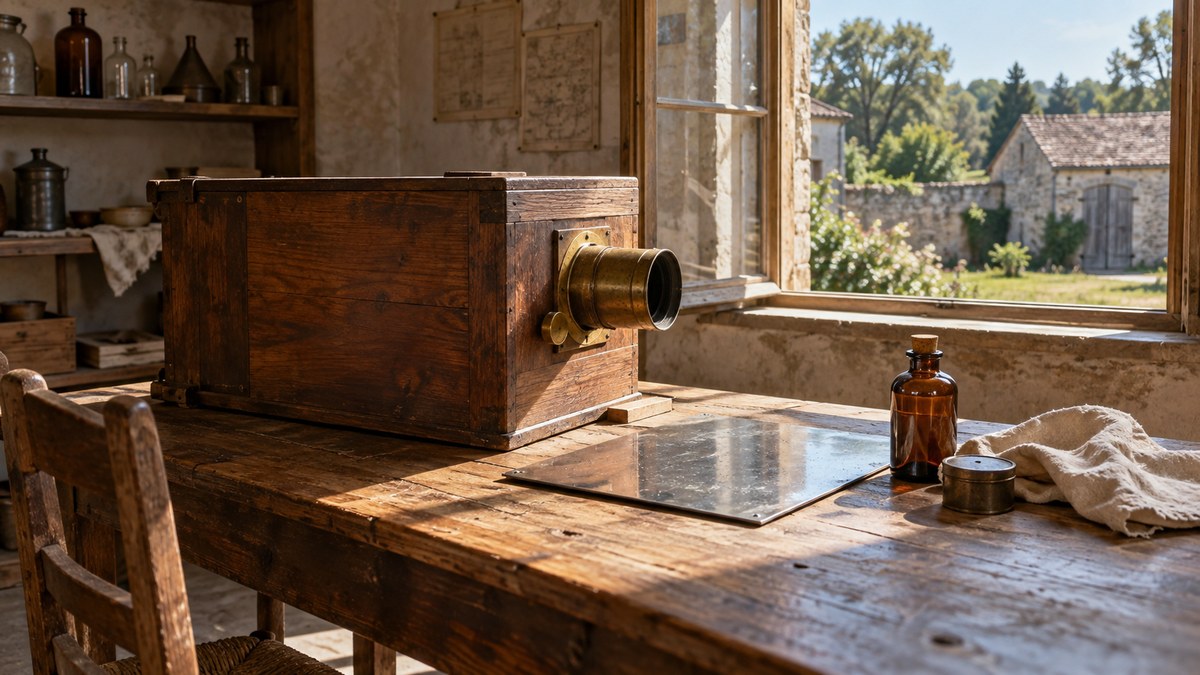
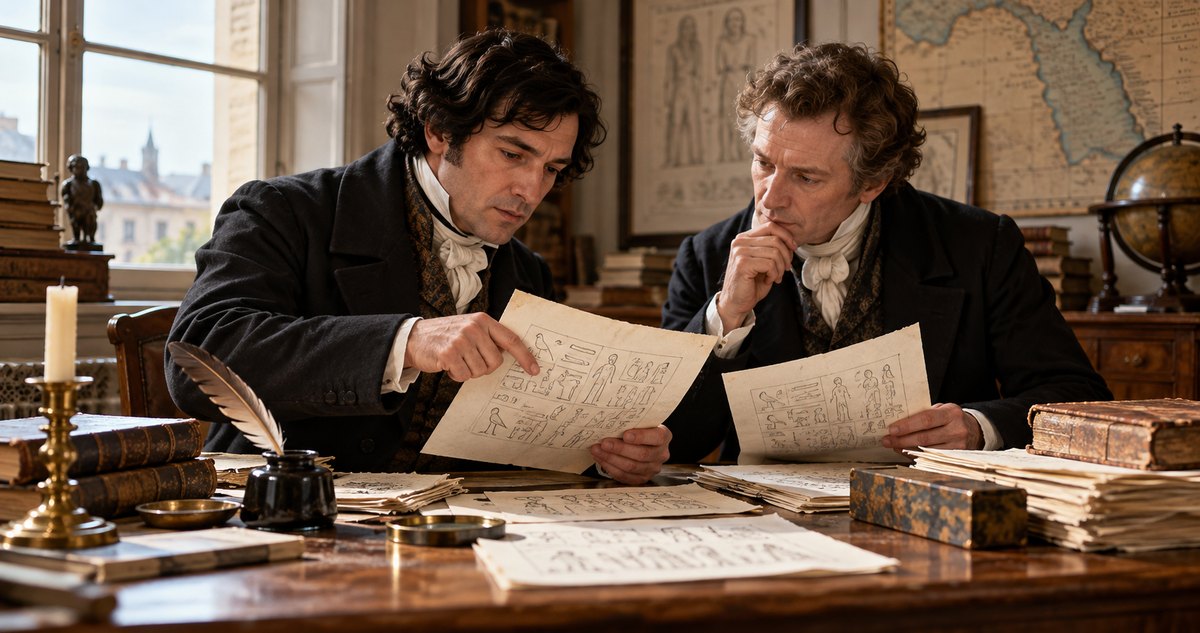
1455: Gutenberg and the Work Behind a Printing Revolution
Movable metal type transformed European book production, but the revolution involved much more than one machine.
Estimated CEFR reading level: C1. A longer historical explanation combining technical processes, cause and consequence, qualified chronology and evaluation of a familiar invention story. This is an editorial estimate, not an official certification.
Five useful words and expressions
British English pronunciation (IPA). Audio uses an available English voice on your device.
movable type /ˌmuːvəbəl ˈtaɪp/
noun phraseSeparate letters or signs that can be arranged and reused to print text.
Movable type allows the same letters to be used in a different arrangement.
standardisation /ˌstændədaɪˈzeɪʃən/
nounThe process of making components follow consistent specifications.
Standardisation helps the metal letters work together on a page.
impression /ɪmˈpreʃən/
nounA mark or printed result produced by pressing one surface against another.
Uneven pressure can produce an unclear impression.
circulation /ˌsɜːkjəˈleɪʃən/
nounThe movement or distribution of material among people.
More copies create possibilities for wider circulation.
precede /prɪˈsiːd/
verbTo occur or exist before something else.
The surviving Jikji volume precedes the Gutenberg Bible.
The story
A book made by a system
The Gutenberg Bible was probably completed in Mainz late in 1455, according to the Library of Congress. Its Latin text usually has forty-two lines in two columns. Capitals and headings were decorated by hand: mechanical printing and older craftsmanship coexisted in the finished book.
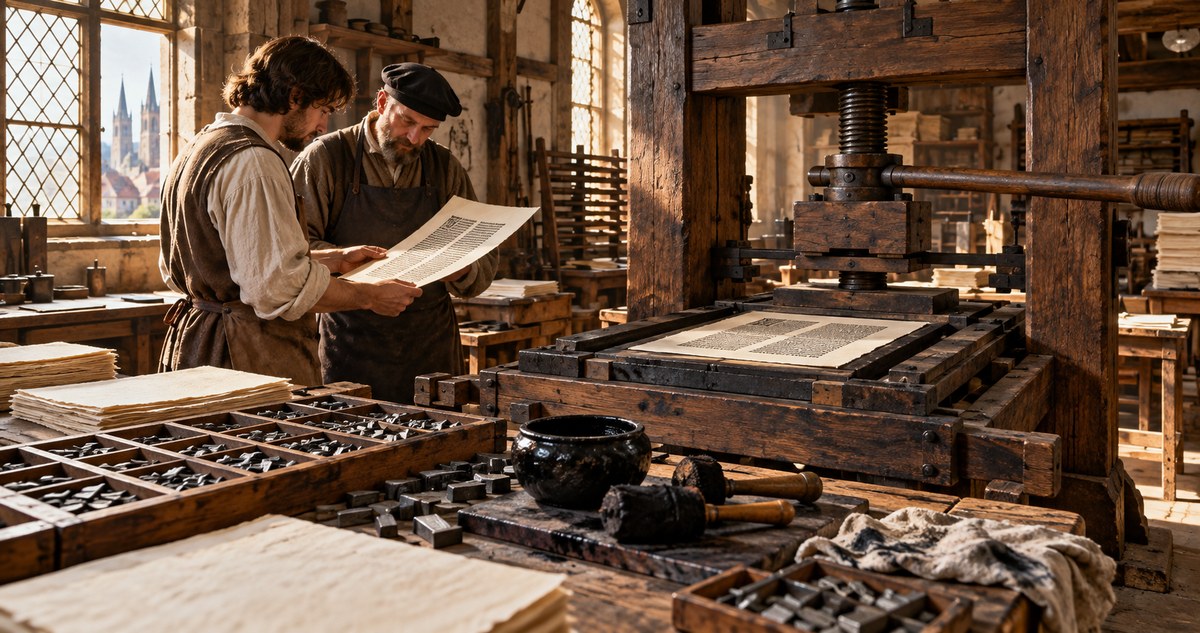
Movable type divides text into reusable letters and signs, assembled into lines and pages. Gutenberg's method cast metal pieces using a hand mould. Their dimensions and durability mattered, but so did suitable ink, paper or parchment, pressure and skilled work. A reliable letter alone could not guarantee a readable page.
Precision and repetition
Imagine reusable building blocks that fail to align. However well each piece is made, the structure will not work unless the pieces fit together. This invented comparison explains why printing required standardisation: metal type, ink, pressure and skilled work had to form a coordinated system before repeated copying became reliable.
Once a page was set, additional impressions could be made without composing the text again. That changed the work required for further copies. However, repetition could multiply mistakes as well as correct passages. Checking a text became especially valuable when its arrangement would be reused.
An earlier history and a cautious comparison
Gutenberg was not the first person anywhere to print with movable metal type. UNESCO records a surviving volume of the Korean Buddhist work Jikji, printed in July 1377. It predates the European milestone without making that milestone unimportant.
The earlier Korean example establishes a sequence of events, but chronology alone cannot prove that knowledge passed directly to Gutenberg. Such influence would require additional evidence. Nor does producing more books automatically make them accessible: readers still need to afford them and understand their language. A technique's existence and its effects on society therefore need separate investigation.
What a reconstruction can explain
The Smithsonian notes uncertainty about Gutenberg's exact press; a wooden frame and screw mechanism offer a plausible reconstruction. A model can explain pressure and printing without being a documented surviving machine. It should clarify a process rather than imply that every workshop detail is known.
Gutenberg's method changed the scale of production through reusable components, while hand-added decoration retained older craftsmanship. In this article's interpretation, the achievement lies in how those practices worked together with precision and checking. Treating the press as part of a wider system gives a fuller explanation of its influence than attributing every social change to one machine.
A repeatable process
- Make consistent piecesCast separate metal letters and signs for repeated use.
- Compose and printArrange a page and transfer ink under pressure.
- Finish and reuseFinish the sheets and rearrange the type for another page.
Original simplified process diagram. It explains a principle, not the exact layout or every step of Gutenberg's workshop.
Three questions
Explain your answer using evidence from the reading before opening the suggested answer.
- Why does the reading describe printing as a system rather than a single invention?
Show answer
Reusable letters, their dimensions, ink, receiving surfaces, pressure and skilled work had to function together. An improvement to only one part would not guarantee reliable pages.
- What does the Jikji example establish, and what does it not establish?
Show answer
It establishes that printing with movable metal type existed before Gutenberg's European milestone. The earlier date alone does not prove that knowledge passed directly from Korea to Gutenberg.
- How do hand-added decoration and uncertainty about the press qualify a simple revolution story?
Show answer
Hand decoration shows continuity with earlier craftsmanship. Uncertainty about the machine reminds us that useful modern reconstructions are not complete documentary evidence.
Let's talk about it
A few ideas to chat about - pick any that interest you.
- What modern invention relies on skills or tools that rarely get much attention?
- Has having more copies of something made it easier for you to access?
- What would you want a museum label to explain about a reconstructed printing press?
- Would you rather watch an old printing press at work or help arrange the type for a page?
- How do you think you would choose what to read if producing each book took much more time and effort?
Cause, sequence and cautious inference
Distinguish preceded from influenced, made possible from guaranteed, and probably from certainly. Write three sentences about printing, choosing one expression from each pair. Explain why your choices match the evidence.
Sources and context
An original learning article by Poly-Puff, written from the factual sources below. Sources checked on 6 October 2026. The artwork and learning activities were created for this article.
Around 1455 is a probable completion milestone, not a verified day of publication. The Korean example establishes earlier use of movable metal type, not a documented line of influence. Analogies and observations about access and editorial responsibility are the lesson's interpretation.