1851: The Great Exhibition Puts Progress on Display
The Great Exhibition gathered industrial products and design in a remarkable glass building. Its displays expressed ideas about progress, taste and power.
Estimated CEFR reading level: C1. A qualified historical argument that connects architecture, access and interpretation, using abstract vocabulary and concession. This is an editorial estimate, not an official certification.
Five useful words
British English pronunciation (IPA). Audio uses an available English voice on your device.
manufactured /ˌmænjʊˈfæktʃəd/
adjectiveMade through an organised production process.
Manufactured goods filled the exhibition.
admission /ədˈmɪʃən/
nounEntry to a place or event, or a charge for entering.
Cheaper admission helped attract more visitors.
imperial /ɪmˈpɪəriəl/
adjectiveConnected with an empire and its authority.
The layout reflected imperial relationships.
domestic /dəˈmestɪk/
adjectiveRelating to one's own country.
Critics wanted to improve domestic design.
spectacle /ˈspektəkəl/
nounAn impressive public display or event.
The glass building created a remarkable spectacle.
The story
A building as an exhibit
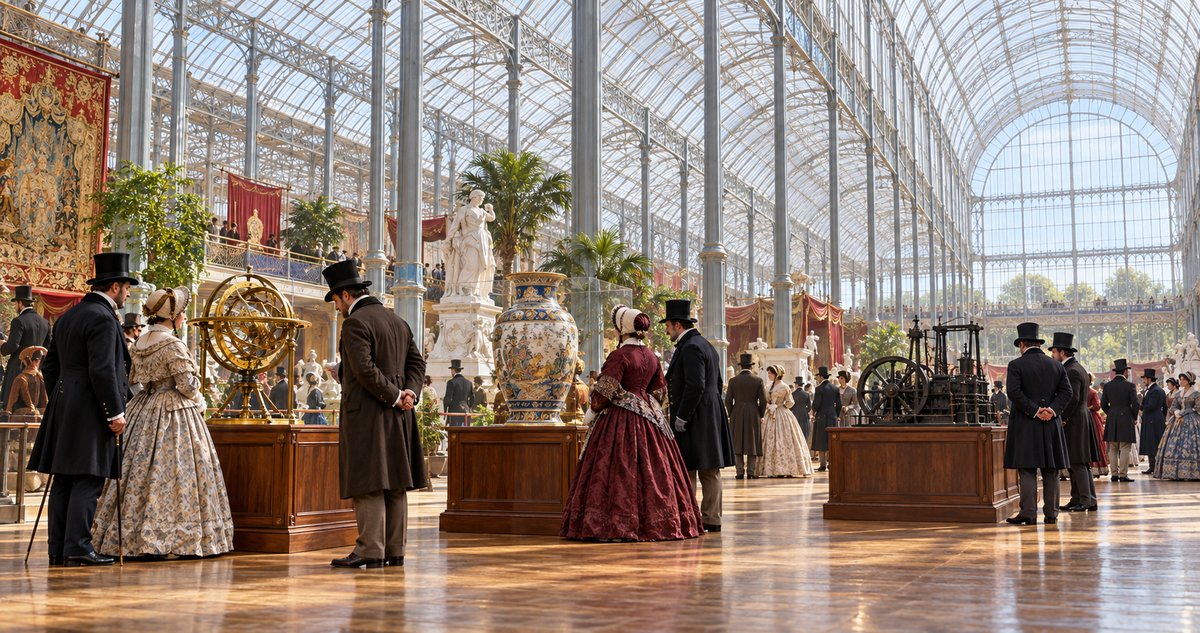
On 1 May 1851, Queen Victoria opened the Great Exhibition in London's Hyde Park. Prince Albert and the organiser Henry Cole helped develop a project that brought manufactured objects, machinery and design from many parts of the world into one space. It invited visitors to compare what different producers could achieve.
The setting reinforced that message. Joseph Paxton's Crystal Palace used a framework of iron and large areas of glass. Its repeated structural parts demonstrated a practical approach to construction, while daylight made the displays visible. The building was therefore more than a container: it was itself an example of the industrial possibilities the exhibition promoted.
Who entered, and who was represented?
Over six million visits were recorded during the exhibition. That figure measures admissions, so it should not automatically be read as six million different individuals. Lower-priced tickets, including one-shilling admission, helped broaden access beyond the wealthiest visitors. Nevertheless, a cheaper ticket did not make travel or time away from work equally available to everyone.
The layout also conveyed a view of international relationships. Britain and territories within its empire occupied the western side, while foreign exhibitors shared the eastern side. The London Archives describes the exhibition as promoting British imperial power. Visitors were therefore seeing objects arranged within a political and trading framework, rather than a neutral catalogue of the world.
Yet admiration did not flow in only one direction. The V&A's account explains how textiles and other work from India impressed critics concerned with improving British design. An exhibition associated with national confidence could also expose weaknesses in domestic taste and encourage learning from elsewhere.
Beyond a temporary spectacle
Its educational ambitions outlasted the event. Selected objects became part of the foundation collections of the museum now known as the V&A. The Crystal Palace itself was later dismantled and rebuilt at Sydenham, where it served a different programme; that later building should not be confused with the original Hyde Park setting.
The exhibition connected industrial display with decisions about design, education and Britain's place in the world. Its legacy includes ingenious construction, museum collections and learning from other producers. Appreciating those achievements also requires asking whose work was displayed, who could attend and how imperial authority shaped the spectacle. Those questions help explain what visitors were being invited to admire.
One exhibition, two sites
- 1 May 1851The exhibition opens in Hyde Park.
- 11 October 1851The exhibition closes to the public; a final ceremony follows on 15 October.
- 1854The rebuilt Crystal Palace opens at Sydenham.
- 1936Fire destroys the later Sydenham building.
Source dates are historical milestones, separate from the learning article publication date.
Three questions
Try answering before you open the answer. You can use your own words.
- Why was the Crystal Palace more than a container for exhibits?
Show answer
Its iron-and-glass construction itself demonstrated industrial possibilities.
- Why should six million visits not automatically mean six million different people?
Show answer
Visits count admissions, which can include repeat visitors.
- How could the exhibition challenge British confidence as well as express it?
Show answer
Critics admired work from India and used it to question and improve British design.
Let's talk about it
A few ideas to chat about - pick any that interest you.
- Have you visited an exhibition whose layout changed how you saw the objects?
- What costs besides a ticket might stop you from attending an event?
- How would you feel about an exhibition that celebrated invention while also exploring unequal power?
- If you were planning an exhibition about invention today, what everyday work would you want visitors to notice?
- Would you rather see a machine operating or hear the story of the people who made it?
Practise a useful pattern
Use concession to qualify an interpretation: "Although the exhibition celebrated British industry, critics learned from foreign designs." Write a paragraph using although, nevertheless and yet to explain two different aspects of the event.
Frequently asked questions
Was the original Crystal Palace at Sydenham?
No. The 1851 exhibition took place in Hyde Park. The building was later dismantled and rebuilt at Sydenham.
Does the attendance total count unique people?
The London Archives reports more than six million visits. Admissions can include repeat visits, so the number should be described carefully.
Sources and editorial notes
Original learning article by Poly-Puff, written from the factual sources below. Sources checked on 11 October 2026. The artwork and learning activities were created for this article.
The historic date is the opening. Royal Collection Trust distinguishes the public closing on 11 October 1851 from the final ceremony on 15 October. The reading avoids inconsistent national exhibit counts. Access costs beyond ticket price are an editorial inference, rather than a visitor-survey result. The reconstruction depicts a plausible hall, not a verified inventory of one gallery.
- Victoria and Albert Museum: architecture, international design and museum collections
- The London Archives: visits, ticket prices, imperial display and the later Crystal Palace
- The Royal Parks: Hyde Park and the opening on 1 May 1851
- Royal Collection Trust: opening, admission prices and the two closing dates