World Mental Health Day 2026: Who Gets a Say?
WHO's World Mental Health Day campaign asks whose experience shapes mental health services, and whether being heard leads to influence over decisions.
Estimated CEFR reading level: C2. A compact argument using qualification, institutional vocabulary, hypothetical examples and evaluation of evidence. This is an editorial estimate, not an official certification.
Five useful words
British English pronunciation (IPA). Audio uses an available English voice on your device.
lived experience /ˌlɪvd ɪkˈspɪəriəns/
noun phraseKnowledge gained through personal experience.
The panel included people with lived experience.
tokenism /ˈtəʊkənɪzəm/
nounA symbolic gesture that offers little real influence.
One invitation alone may amount to tokenism.
co-create /ˌkəʊkriˈeɪt/
verbTo develop something jointly.
Participants helped co-create the service.
representation /ˌreprɪzenˈteɪʃən/
nounThe inclusion of people or perspectives in a decision.
The group questioned whose representation was missing.
scrutinise /ˈskruːtɪnaɪz/
verbTo examine something carefully.
Readers should scrutinise claims of progress.
The story
What is the 2026 theme?
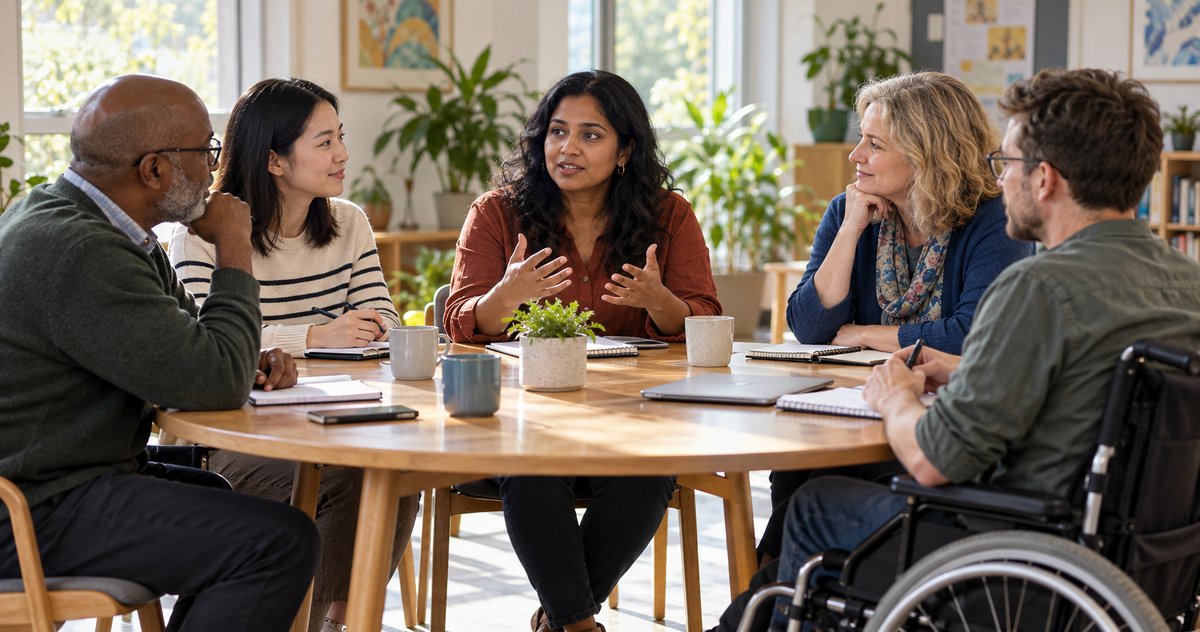
World Mental Health Day falls on 10 October. For 2026, the World Health Organization uses the theme "Lived experiences heard: real voices, real change". The campaign highlights people whose understanding of mental health services comes from using them, seeking support or encountering barriers to care. Their knowledge can reveal problems that professional training alone may overlook.
Someone may be invited to describe their experience while an organisation keeps control of all decisions. Their testimony can attract attention without changing the service. The central question is therefore whether people with lived experience help shape priorities, rather than only explain the effects of priorities chosen by others. Visibility and influence are related, but they are not equivalent.
What would influence look like?
WHO's 2023 framework describes meaningful engagement as participation in developing policies, programmes and services. A 2024 World Health Assembly resolution adds support for sustained social participation. Together, these provide background for the current campaign; their publication does not establish that every health system has implemented them.
Consider a fictional service redesign. Users explain that an appointment system is difficult to navigate. If managers merely thank them, the consultation produces a record of listening. If users help compare alternatives, examine the proposed design and review whether it works, their contribution extends into the decision itself. This example illustrates the distinction; it is not a report of a WHO project.
Who is still missing?
Participation also raises a problem of representation. A single articulate speaker cannot automatically represent everyone who has sought mental health support. Differences in language, resources and circumstances may shape which barriers people encounter and which meetings they can attend. A process that rewards only the easiest voices to hear risks reproducing the exclusions it claims to address.
Evaluating participation means examining how the process works. Participants need opportunities to help set the agenda, disagree, understand the information and hear what happened to their recommendations. These arrangements can reveal whether their involvement has substance. They provide a way to assess decision-making, rather than guaranteeing any particular clinical outcome or assuming that everyone will want the same change.
How should readers judge progress?
A campaign theme expresses a purpose; evidence of progress needs to show what happened afterwards. Publicity does not necessarily give participants more authority, and one successful consultation cannot demonstrate change throughout a health system. Reports can be more informative when they identify participants' recommendations, which were adopted and how disagreements were handled.
Unresolved questions also belong in an honest account of participation. People with personal experience may disagree about the best response. A process that allows those differences can provide more insight than an account that treats unanimous approval as the only acceptable result.
The phrases "people were consulted" and "people helped decide" illustrate the difference. Both may be accurate, but the second describes greater influence over the outcome. Connecting recognition with that influence is the campaign's challenge. Careful reading helps us see what each reported activity establishes, while recognising that meaningful participation can include disagreement.
Three questions
Try answering before you open the answer. You can use your own words.
- What distinction organises the article?
Show answer
The distinction between being listened to and influencing decisions.
- Which example is hypothetical?
Show answer
The appointment-system redesign. It is not a reported WHO project.
- Why is publicity insufficient evidence of progress?
Show answer
It shows visibility, but does not establish a change in decision-making authority or implementation.
Let's talk about it
A few ideas to chat about - pick any that interest you.
- What would make you feel that a consultation was worth taking part in?
- How could a group welcome people who find meetings difficult to attend?
- What would reassure you that participants' ideas had influenced a decision?
- What would help participants choose how much personal experience to share in a discussion about mental-health services?
- How could an organisation show that disagreeing with its plans was a welcome part of participation?
Qualified evaluation
Use does not necessarily to limit an inference: "More publicity does not necessarily indicate more influence." Write a similar sentence about another public campaign.
Frequently asked questions
What is WHO's World Mental Health Day 2026 theme?
Lived experiences heard: real voices, real change.
What does lived experience mean here?
Personal experience of mental health conditions and seeking, receiving or being unable to obtain support, rather than knowledge gained only from professional training.
Sources and editorial notes
Original learning article by Poly-Puff, written from the factual sources below. Sources checked on 10 October 2026. The artwork and learning activities were created for this article.
This is a reading about public participation, not an individual treatment guide. Campaign goals are separated from demonstrated results. The redesign example and evaluative questions are original teaching material; no survey percentages or clinical outcomes are claimed.