World Habitat Day 2026: What Makes Housing Adequate?
World Habitat Day puts a practical question at the centre of city life: what does a home need to provide?
Estimated CEFR reading level: C1. Qualified arguments, abstract policy vocabulary and an inference about the difference between constructing buildings and meeting housing needs. This is an editorial estimate, not an official certification.
Five useful words
British English pronunciation (IPA). Audio uses an available English voice on your device.
adequate /ˈædɪkwət/
adjectiveGood enough to meet an important need.
Adequate housing includes reliable basic services.
affordability /əˌfɔːdəˈbɪləti/
nounThe extent to which something can be paid for without serious financial difficulty.
Affordability matters to families with limited incomes.
eviction /ɪˈvɪkʃən/
nounThe act of forcing someone to leave a property.
Residents were worried about eviction.
resilience /rɪˈzɪliəns/
nounThe ability to cope with difficulties and recover.
Safer homes can improve community resilience.
coordinated /kəʊˈɔːdɪneɪtɪd/
adjectiveOrganized so different people or groups work together.
The city needs a coordinated response.
The story
A wider meaning of home
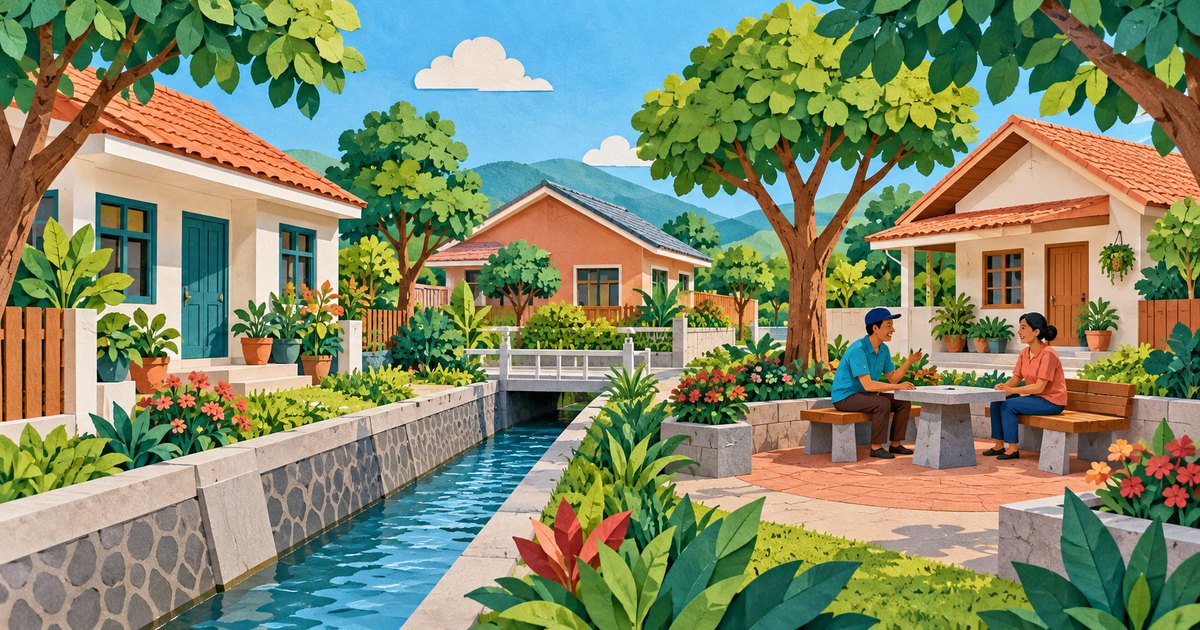
World Habitat Day's global observance took place in Muscat, Oman, on 5 October 2026, with the theme "Adequate Housing for All". It opened Urban October, a month devoted to cities and communities. The theme asks what makes a home adequate: a building can provide shelter while still lacking the conditions needed for a secure and dignified life.
In messages for the day, United Nations leaders described housing as a public priority connected to health, opportunity and resilience. The emphasis matters because counting new buildings alone cannot reveal whether households can afford them, access basic services or remain safely in their homes.
Services and security
The President of the UN Habitat Assembly highlighted clean water, sanitation and protection against eviction. The Executive Director also stressed affordability and connections to services. These concerns overlap. A family may have shelter but still struggle if housing costs consume too much income or if essential services are unreliable.
Consider two hypothetical homes with the same number of rooms. One has dependable water and a manageable rent; the other lacks sanitation and leaves its occupants uncertain about staying. A construction total would count both buildings. A discussion of adequate housing would ask how differently their residents experience daily life.
From a theme to decisions
The Secretary-General called for coordinated action by national and local governments, supported by partnerships and financing. The Assembly President urged improvements to informal settlements. Taken together, these messages frame housing as part of a wider urban system, rather than a task that ends when a roof is completed.
Residents may want to know whether improvements will reach their communities, whether they can remain in their homes during the work and who will maintain shared services afterwards. These questions follow from the theme's wider view of housing. They are issues to investigate, rather than promises that every city has already made or fulfilled.
What the day can show
An international observance creates a shared agenda; it does not by itself demonstrate that housing conditions have improved. Assessing progress requires evidence about affordability, services and security over time. Listening to residents is therefore essential: their experience can expose problems that a headline construction figure misses.
Assessing housing therefore means considering more than the number of completed homes. Affordability, dependable services and security affect whether people can live well in them. Connecting those everyday conditions with the global discussion makes the theme easier to evaluate: progress should be visible in residents' lives, as well as in construction figures.
Three questions
Try answering before you open the answer. You can use your own words.
- Where and when was the global observance held?
Show answer
In Muscat, Oman, on 5 October 2026.
- Why can a building count give an incomplete picture?
Show answer
It does not show whether homes are affordable, connected to services or secure for their residents.
- What would help assess progress after the observance?
Show answer
Evidence about affordability, services and security over time, together with residents' experience.
Let's talk about it
A few ideas to chat about - pick any that interest you.
- Which services make a neighbourhood feel like a good place to live?
- If your city asked about housing, what would you want it to hear?
- What change would make you feel that housing in your area had improved?
- What would make a housing discussion welcoming to people who rent as well as people who own their homes?
- Would you rather improve the homes already in a neighbourhood or build somewhere new if both options were possible?
Practise a useful pattern
Use concession to qualify an argument: "Although a building exists, it may not meet residents' needs." Write two sentences distinguishing the existence of a service from its quality.
Frequently asked questions
What was the World Habitat Day 2026 theme?
The theme was "Adequate Housing for All".
Does adequate housing mean only having a roof?
No. The UN messages also emphasize affordability, basic services and security.
Sources and editorial notes
Original learning article by Poly-Puff, written from the factual sources below. Sources checked on 13 October 2026. The artwork and learning activities were created for this article.
The two-home comparison is an original hypothetical example. Questions about implementation are editorial analysis, not announced local policies. UN pages contain differing global housing estimates, so this reading does not combine them into a single statistic.