1912: Titanic and the Work of Making Ships Safer
Titanic sank on 15 April 1912 after striking an iceberg the night before. The disaster helped drive international safety rules, but its legacy involves training, equipment and continuing oversight as well as a treaty.
Estimated CEFR reading level: C1. Extended cause-and-effect reasoning, institutional vocabulary and careful distinctions between adoption, implementation and outcomes. This is an editorial estimate, not an official certification.
Five useful words
British English pronunciation (IPA). Audio uses an available English voice on your device.
capacity /kəˈpæsəti/
nounThe maximum amount something can hold or accommodate.
Available capacity differs from actual use.
provision /prəˈvɪʒən/
nounAn arrangement or requirement made for a purpose.
The agreement contained a safety provision.
implementation /ˌɪmplɪmenˈteɪʃən/
nounThe process of putting a plan or rule into practice.
Implementation required more than a signed document.
compliance /kəmˈplaɪəns/
nounFollowing applicable rules or requirements.
The report examined compliance with the standard.
vigilance /ˈvɪdʒɪləns/
nounCareful attention to possible danger or problems.
Improved equipment does not remove the need for vigilance.
The story
Collision, sinking and capacity
Titanic struck an iceberg late on 14 April 1912 and sank early on 15 April during its first voyage from Southampton to New York. Around 2,200 passengers and crew were aboard; approximately 1,500 died. The two dates distinguish the collision from the sinking, rather than describing one simultaneous event.
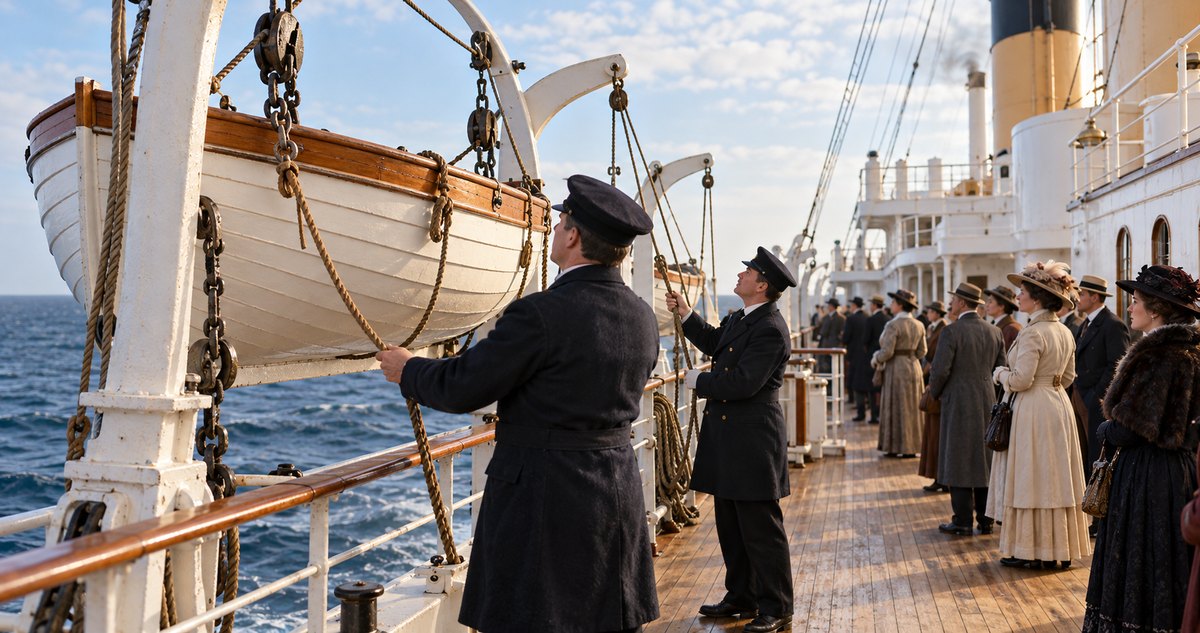
Its twenty lifeboats had room for roughly 1,178 people, fewer than the number aboard. Royal Museums Greenwich also explains that many boats were launched partly empty. There were therefore two separate problems: insufficient total capacity and failure to use all the available places. Safety depended on both provision and effective use.
Agreement before implementation
The disaster prompted the first International Convention for the Safety of Life at Sea, or SOLAS, adopted in 1914. It addressed matters including navigation, ship construction and life-saving arrangements. International voyages made cooperation necessary because ships crossed the boundaries of separate national systems.
However, the 1914 convention never entered into force because of the First World War. Adoption meant agreement on its text, not legal operation. Later conventions followed, including one in 1929. Reform began after the disaster without becoming an immediate, complete solution.
Equipment needs a working procedure
Imagine a fictional ship with emergency places for everyone, but poorly maintained launching equipment and unclear assembly instructions. Passengers might still struggle to reach safety. This invented example shows how design, training, communication and procedures depend on one another. It illustrates a general preparedness problem without making an additional claim about what happened aboard Titanic.
A radio is useful when messages can reach someone able to respond. Survival craft help when people can reach and operate them. The International Maritime Organization's account of Titanic's legacy connects improved equipment with trained personnel. Compliance must involve working arrangements as well as written standards.
A legacy that requires vigilance
The IMO's centenary reflection emphasised that safety requires continued implementation and improvement as new vessels introduce new challenges. Technology cannot replace maintenance or updated protection. Announcing a rule, adopting it, enforcing it and revising it are distinct stages. Each stage needs evidence that the intended work has actually taken place.
In this article's interpretation, Titanic's legacy calls for preparation that people can rely on: adequate equipment, training and checks that arrangements work in practice. Remembering those who died remains central to the history. Understanding how reforms are implemented helps explain their significance without assuming that a treaty or impressive machine can permanently resolve every safety problem.
Historical milestones
- 14 April 1912Late-evening collision with an iceberg.
- 15 April 1912The ship sinks in the early hours.
- 1914The first SOLAS convention is adopted but does not enter into force.
- 1929A later SOLAS convention follows.
Original learning guide by Poly-Puff, based on the sources below.
Three questions
Try answering before you open the answer. You can use your own words.
- Why does the article give both 14 and 15 April?
Show answer
The collision occurred late on 14 April; the sinking followed early on 15 April.
- What distinction does the lifeboat example establish?
Show answer
Enough potential places and effective use of those places are separate questions.
- Why is adopted in 1914 different from entered into force?
Show answer
Adoption means agreement on the text; the 1914 convention never entered into force because of the war.
Let's talk about it
A few ideas to chat about - pick any that interest you.
- Have you ever practised an emergency plan that looked easier on paper?
- Why do you think some safety changes receive attention only after a disaster?
- What everyday situation comes to mind where equipment and training need to work together?
- What would make a safety demonstration feel worth your attention on a journey you had taken many times?
- How might a museum connect Titanic's story with the quieter work of maintaining safety every day?
Cause without overstatement
Compare "helped drive reform" with "solved the problem". The first describes a contribution; the second claims a complete outcome. Write three sentences about a historical reform, distinguishing its trigger, the decision and the later implementation.
Frequently asked questions
When did Titanic sink?
It sank early on 15 April 1912, after striking an iceberg late on 14 April.
Did the 1914 SOLAS convention enter into force?
No. The First World War prevented it from entering into force; later conventions continued the development of international rules.
Sources and context
An original learning article by Poly-Puff, written from the factual sources below. Sources checked on 9 October 2026. The artwork and learning activities were created for this article.
Passenger and casualty totals are rounded because historical totals vary by source. The 1914 adoption is separated from legal entry into force. The hypothetical ship is an original explanatory example, and the closing argument is editorial analysis. This is historical reading practice, not an inspection guide. The image shows a generic period ship, not Titanic.
- Royal Museums Greenwich: Titanic facts and lifeboat capacity
- Titanic Belfast: collision and sinking chronology
- IMO: 1914 convention and its failure to enter into force
- IMO: successive SOLAS conventions
- IMO: equipment, communication and training in the safety legacy
- IMO: 2012 centenary reflection on continuing improvement