1825: A Railway Journey That Helped Change Travel
An early public railway carried goods and passengers behind a steam locomotive.
Estimated CEFR reading level: B1. A chronological historical explanation with comparisons and a distinction between an invention and its wider use. This is an editorial estimate, not an official certification.
Five useful words
British English pronunciation (IPA). Audio uses an available English voice on your device.
locomotive /ˌləʊkəˈməʊtɪv/
nounA railway vehicle that provides power to pull a train.
The locomotive pulled three carriages.
wagon /ˈwæɡən/
nounA railway vehicle used to carry goods.
The wagons were full of coal.
haul /hɔːl/
verbTo pull or transport something heavy.
The truck hauled equipment to the building site.
goods /ɡʊdz/
plural nounThings that are made, bought, sold or transported.
The ship carried goods to several ports.
preserve /prɪˈzɜːv/
verbTo keep something and protect it from damage or loss.
The museum preserves tools from the old factory.
The story
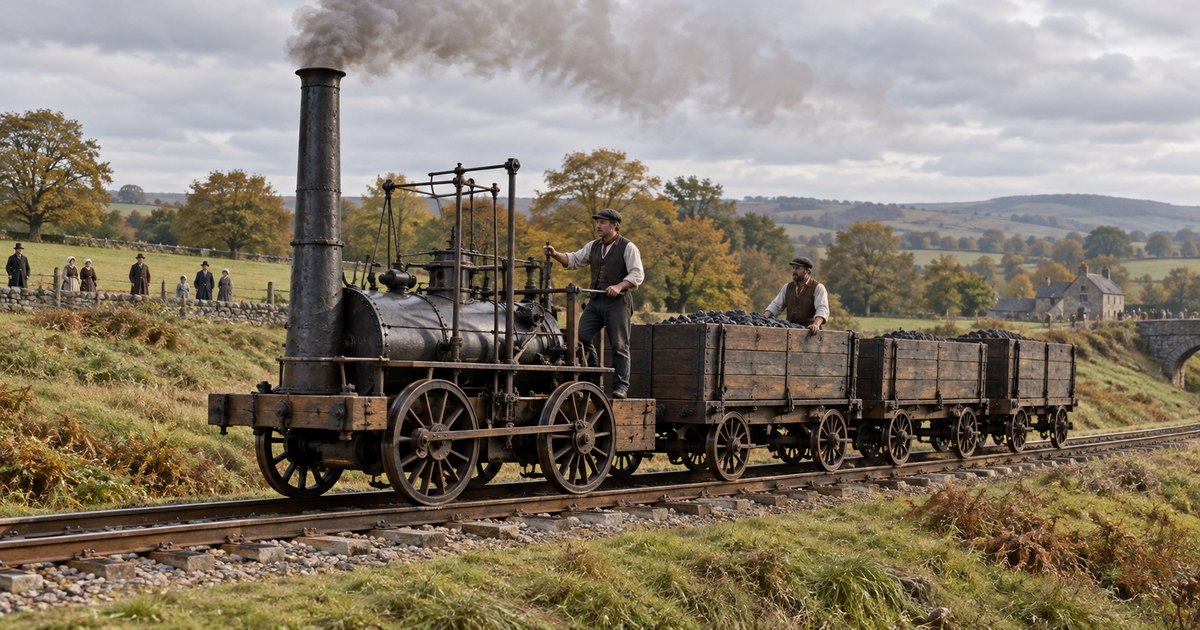
The Stockton and Darlington Railway opened on 27 September 1825 in north-east England. It connected coal-producing areas with Darlington and the port of Stockton. Moving heavy goods was an important purpose.
George Stephenson drove Locomotion No. 1 on opening day. It hauled goods wagons and passengers while crowds watched. The journey showed how steam power could carry people on a public railway.
It was not the first railway or steam engine. Earlier examples existed. Horses also continued pulling many trains in the line's early years; modern services did not appear overnight.
Locomotion No. 1 was later preserved as a museum object. It had been rebuilt several times, so not all its surviving parts are unchanged from 1825. The engine helps explain the transport milestone, while the opening-day journey shows how people put steam power to use.
Opening, working and preserving
- 1821Parliament authorises the Stockton and Darlington Railway.
- 27 September 1825Locomotion No. 1 hauls the opening train.
- 1857The rebuilt locomotive is placed on display at Darlington.
An original timeline with selected milestones. The preserved locomotive has been altered and restored over time.
Three questions
Try answering before you open the answer. You can use your own words.
- Why was moving goods important to the new line?
Show answer
The railway connected coal-producing areas with Darlington and the port of Stockton.
- Was this the first railway or the first steam engine?
Show answer
No. Earlier railways and steam locomotives existed; this was an important public steam-hauled passenger journey.
- Why is the surviving engine not an unchanged copy of the 1825 machine?
Show answer
It was rebuilt several times and later restored.
Let's talk about it
A few ideas to chat about - pick any that interest you.
- What is the most useful way to travel in your area?
- Which old machine would you like to see in a museum?
- Have you seen an existing invention put to a surprising new use?
- Would you like to take a short trip on an old steam train?
- What might make people nervous about trying a completely new way to travel?
Past activity and completed events
Compare "Crowds were watching" with "The train left the station." The past continuous describes an activity in progress; the simple past describes a completed event. Write a sentence using both forms.
Sources and context
An original learning article by Poly-Puff, written from the factual sources below. Sources checked on 5 October 2026. The artwork and learning activities were created for this article.