1957: Sputnik Sends a Small Signal Around the World
A metal ball with four long antennas became a symbol of a new age. Its simple radio signal showed that a human-made object could circle Earth.
Estimated CEFR reading level: B1. Past-tense narration, clear cause and effect, and a small set of explained space-science words. This is an editorial estimate, not an official certification.
Five useful words
British English pronunciation (IPA). Audio uses an available English voice on your device.
launch /lɔːntʃ/
verbTo send a rocket or spacecraft on its journey.
The team plans to launch a small spacecraft.
satellite /ˈsætəlaɪt/
nounAn object that travels around a planet or another object in space.
The satellite travels around Earth.
orbit /ˈɔːbɪt/
verbTo move around another object in space.
The Moon orbits Earth.
antenna /ænˈtenə/
nounA part that sends or receives radio signals.
The radio has a long antenna.
signal /ˈsɪɡnəl/
nounA sound or other message used to communicate information.
We could hear the repeated signal.
The story
A new object in the sky
On 4 October 1957, the Soviet Union launched Sputnik 1. It was the first artificial satellite to orbit Earth. A satellite is an object that travels around another object in space.
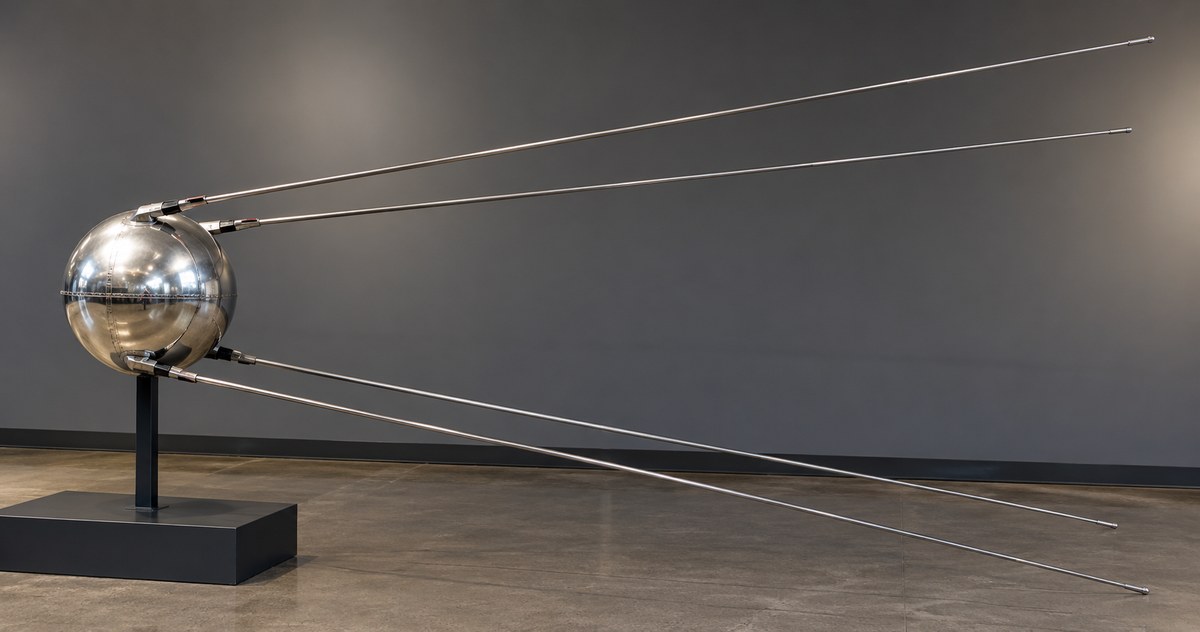
Sputnik was a metal sphere, about fifty-eight centimetres wide, with four long antennas. It had no people inside. Its radio equipment sent a repeated signal that could be heard on Earth.
Why the signal mattered
NASA says the satellite took about ninety-eight minutes to travel around Earth. Although Sputnik was small, putting it into orbit was a major engineering achievement. Its repeated journeys showed that a human-made object could keep travelling around the planet.
The launch began the space age and increased competition between the Soviet Union and the United States. It also raised new questions about what rockets could do.
Sputnik did not land on the Moon. That came later. Its achievement was a first step: showing that an object made on Earth could keep circling the planet.
Three questions
Try answering before you open the answer. You can use your own words.
- Which country launched Sputnik 1, and when?
Show answer
The Soviet Union launched it on 4 October 1957.
- Was anyone travelling inside Sputnik?
Show answer
No. It was an uncrewed satellite.
- What important achievement did the launch demonstrate?
Show answer
Engineers could put a human-made object into orbit around Earth.
Let's talk about it
A few ideas to chat about - pick any that interest you.
- What small invention has made a big difference in your life?
- Would you rather explore space through a museum, a film or a book?
- Do you think competition makes scientific work more exciting, or more difficult?
- Would you enjoy listening to a recording of Sputnik's signal in a museum?
- What would you want to tell someone who had just heard about the first satellite?
Practise a useful pattern
Use the past simple for completed events: "The Soviet Union launched Sputnik in 1957." Write three sentences about a useful invention. Use a past-tense verb and a finished-time expression.
Frequently asked questions
Was Sputnik the first human-made satellite?
Yes. Sputnik 1 became the first artificial satellite to orbit Earth on 4 October 1957.
Is the hero image an original photograph of Sputnik?
No. It is an AI-generated photo-style reconstruction showing a physical replica in a modern museum setting.
Sources and editorial notes
Original learning article by Poly-Puff, written from the factual sources below. Sources checked on 12 October 2026. The artwork and learning activities were created for this article.
The 1957 launch date is separate from this lesson's 12 October 2026 publication date. The spacecraft was uncrewed; the image represents a replica rather than an actual mission photograph.