Mars Rocks Tell a Story About Water
A rover finds clues that water changed some Martian rocks more than once.
Estimated CEFR reading level: B1. Connected factual text with cause-and-effect language. Scientific words are explained below. This is an editorial estimate, not an official certification.
Five useful words
British English pronunciation (IPA). Audio uses an available English voice on your device.
mineral /ˈmɪnərəl/
nounA natural substance that forms part of a rock.
This mineral has a bright green colour.
rover /ˈrəʊvə/
nounA vehicle that moves around to explore a place.
The rover stopped beside a large rock.
ancient /ˈeɪnʃənt/
adjectiveFrom a very long time ago.
We visited an ancient city.
instrument /ˈɪnstrəmənt/
nounA tool used to measure or examine something.
The instrument measures the temperature.
evidence /ˈevɪdəns/
nounInformation that helps show whether an idea is true.
We need more evidence before we decide.
The story
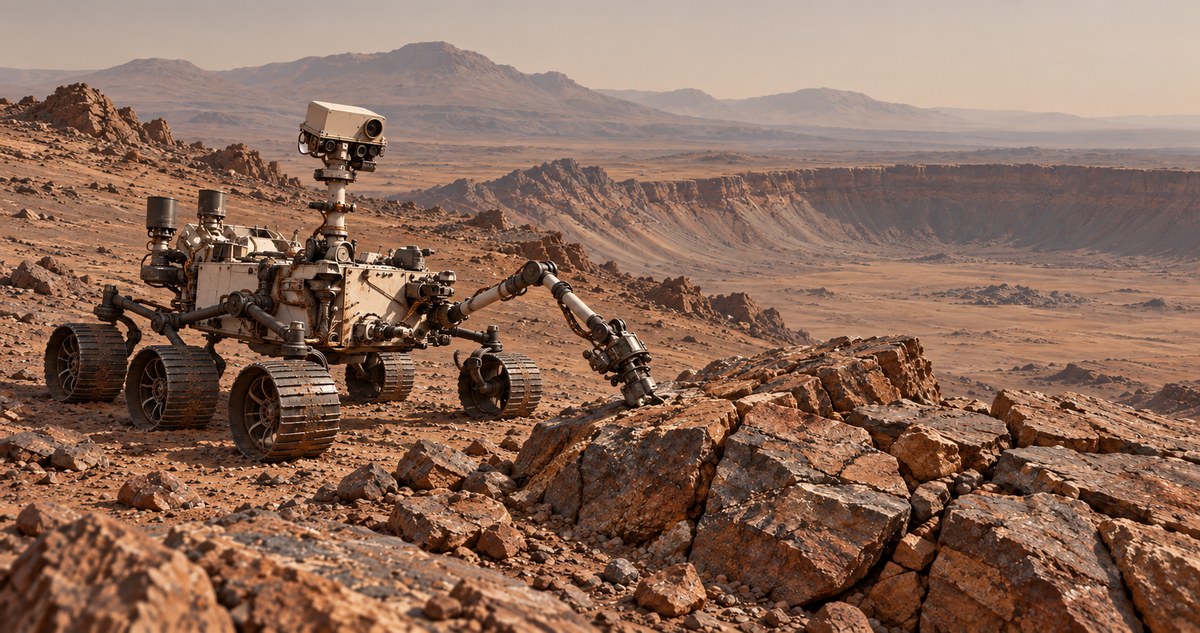
On 21 September 2026, NASA reported research on rocks in Jezero Crater, Mars. The Perseverance rover found signs that water had changed some Margin Unit rocks on at least three occasions.
The rocks formed from hot material beneath the ground. Later, water moved through cracks. One event may have involved an ancient lake; another involved hot water underground. Scientists could work out their order, but not their exact ages.
Perseverance's SuperCam instrument uses a laser to study rocks from a distance. Light produced in the process helps identify their chemicals and minerals.
Water-related changes help scientists understand early Mars, but they do not prove that life existed there. Researchers need several pieces of evidence to test that possibility. The rocks show where water has acted; finding out whether anything lived in those places is a separate question.
How a rock becomes a clue
- Water meets rockWater moves through cracks and can change minerals.
- The rover measuresSuperCam examines light to learn about the rock's chemistry.
- Scientists interpretThe team compares the clues and suggests an order of events.
A simplified process diagram by Poly-Puff. It shows the idea, not the scale or exact timing.
Three questions
Try answering before you open the answer. You can use your own words.
- What did researchers find in some Margin Unit rocks?
Show answer
Signs that water had changed them on at least three occasions.
- What could the team work out, and what remained unknown?
Show answer
They could work out the order of the water events, but not their exact ages.
- Does evidence of water prove that Mars had life?
Show answer
No. Water-related changes alone do not prove that life existed.
Let's talk about it
A few ideas to chat about - pick any that interest you.
- Would you rather explore Mars with a robot or visit it yourself?
- What objects around you hold clues about the past?
- What would you most like scientists to find out about Mars?
- Would you enjoy helping choose which rocks a Mars robot should study?
- What would make a display of rocks from Mars interesting to someone who knows little about science?
Talking about possibilities
Compare "Water changed these rocks" with "One event may have been connected to a lake." May have been shows that an explanation is possible, rather than certain. Write a sentence about something that may have happened in the past.
Sources and context
An original learning article by Poly-Puff, written from the factual sources below. Sources checked on 4 October 2026. The artwork and learning activities were created for this article.