The 2026 Physics Nobel: Listening to the Universe with IceCube
Francis Halzen has won the 2026 Physics Nobel for work on IceCube and high-energy neutrinos from space. How can buried sensors reveal distant events?
Estimated CEFR reading level: B2. A short scientific explanation with cause-and-effect links and technical terms explained in context. This is an editorial estimate, not an official certification.
Five useful words
British English pronunciation (IPA). Audio uses an available English voice on your device.
observatory /əbˈzɜːvətri/
nounA place or instrument used to study events in space.
IceCube is a particle observatory.
sensor /ˈsensə/
nounA device that detects a physical change or signal.
The sensors record faint light.
interact /ˌɪntərˈækt/
verbTo affect or respond to something else.
Most neutrinos rarely interact with matter.
indirect /ˌɪndəˈrekt/
adjectiveObtained through something else rather than directly.
The light provides indirect evidence.
collaboration /kəˌlæbəˈreɪʃən/
nounPeople working together towards a shared goal.
The discovery depended on a research collaboration.
The story
An unusual observatory
On 6 October 2026, the Nobel Prize in Physics was awarded to Francis Halzen for his contributions to IceCube and the discovery of high-energy astrophysical neutrinos. The award recognises years of scientific work, rather than a discovery made that morning.
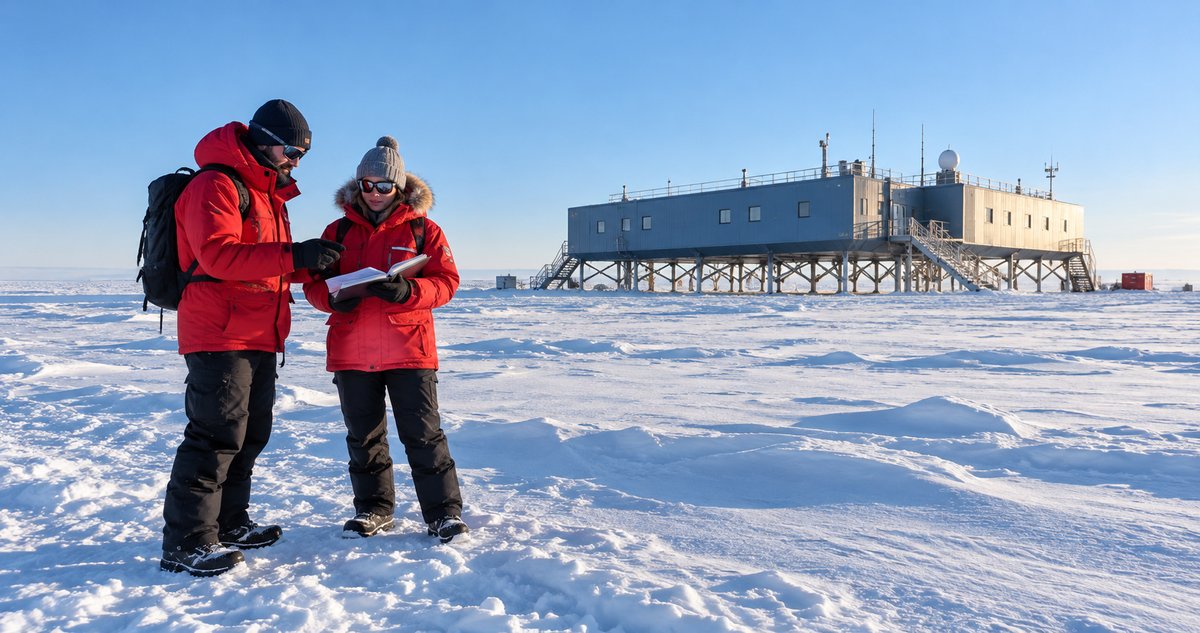
IceCube is a particle observatory at the South Pole. Its sensors sit deep inside Antarctic ice. Instead of collecting ordinary starlight, it searches for evidence of neutrinos: tiny particles that can travel enormous distances through space.
Reading a faint signal
Most neutrinos pass through matter without interacting. Occasionally, one interacts with material near the detector and creates other particles. These produce light, which the buried sensors record. Researchers use the pattern and timing of that light to estimate the neutrino's direction and energy.
IceCube gives scientists another way to investigate powerful events in the universe. Its evidence is indirect: the sensors record light from particles created when a neutrino interacts with nearby matter. Scientists must analyse those signals carefully to learn about the original neutrino. That work involves a large research collaboration.
Three questions
Try answering before you open the answer. You can use your own words.
- What does the award recognise?
Show answer
Halzen's contributions to IceCube and the discovery of high-energy astrophysical neutrinos.
- What do IceCube's sensors record?
Show answer
Light produced by other particles after a neutrino interaction.
- How can researchers estimate a neutrino's direction and energy?
Show answer
By analysing the pattern and timing of the recorded light.
Let's talk about it
A few ideas to chat about - pick any that interest you.
- What do you find most surprising about studying space from deep inside ice?
- Can you think of something you know about through clues rather than seeing it directly?
- How do you feel about an individual receiving a prize for work involving a large team?
- Would you rather visit a remote research station or speak to its scientists from home?
- What would make a story about an invisible particle exciting for someone who usually avoids physics?
Practise a useful pattern
Explain a process with occasionally, then and therefore. Write three sentences describing how a rare neutrino interaction becomes a recorded signal. Keep the distinction between the neutrino and the light-producing particles clear.
Frequently asked questions
Is IceCube an ordinary telescope?
No. It uses sensors buried in Antarctic ice to detect light from particle interactions.
Did the discovery happen on the announcement day?
No. The 6 October 2026 announcement recognises work developed over many years.
Sources and editorial notes
Original learning article by Poly-Puff, written from the factual sources below. Sources checked on 11 October 2026. The artwork and learning activities were created for this article.
Fermilab reproduces the Royal Swedish Academy of Sciences announcement. The detector explanation is checked against IceCube's own science pages. This reading distinguishes the award announcement from the earlier research.