1827: The Photograph That Refused to Disappear
Niépce's view from a window looks faint beside a phone photo. Keeping the image at all was the breakthrough.
Estimated CEFR reading level: C1. An extended explanation connects technical innovation, historical evidence and the precise limits of a claim to be first. This is an editorial estimate, not an official certification.
Five useful words
British English pronunciation (IPA). Audio uses an available English voice on your device.
fleeting /ˈfliːtɪŋ/
adjectiveLasting for only a short time.
The earlier image was fleeting.
retain /rɪˈteɪn/
verbTo keep something rather than lose it.
The new surface could retain an image.
apparatus /ˌæpəˈreɪtəs/
nounEquipment arranged for a particular purpose.
The apparatus formed an image inside the box.
qualification /ˌkwɒlɪfɪˈkeɪʃən/
nounA detail that limits or makes a statement more precise.
The word surviving is an important qualification.
conservation /ˌkɒnsəˈveɪʃən/
nounWork that protects an object from damage or decay.
Conservation helps protect the historic plate.
The story
A view of a courtyard hardly sounds revolutionary. Yet a faint image on a small metal plate marks an extraordinary change in what people could preserve. The Harry Ransom Center dates Joseph Nicéphore Niépce's View from the Window at Le Gras to 1827 and describes it as the earliest surviving photograph produced with a camera obscura. The qualification matters: surviving evidence is not a complete record of every experiment.
Niépce was trying to solve a problem that a modern phone makes easy to overlook. A camera obscura could form an image of the outside world, but forming an image and retaining it were different achievements. Earlier pictures from his experiments had been fleeting. What he needed was a surface on which the effect of light would persist after the apparatus was put away.
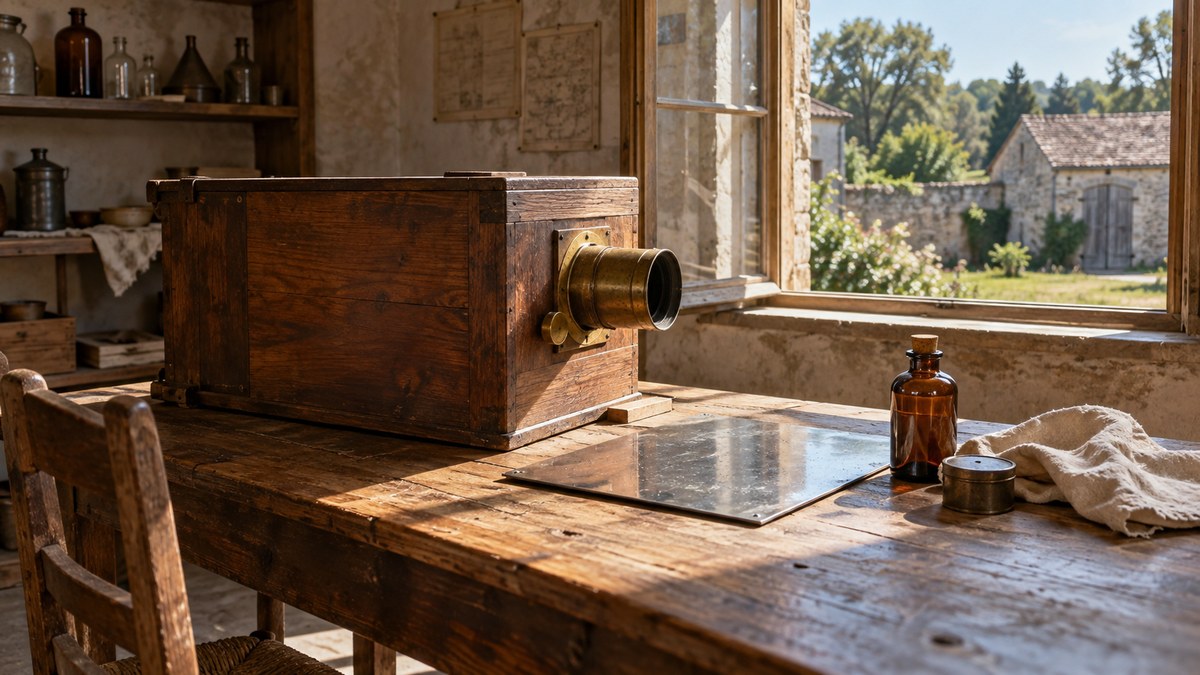
His method, called heliography, joined optical equipment to a chemical process. According to the Ransom Center, he coated a polished pewter plate with light-sensitive bitumen dissolved in lavender oil, placed it in the camera and exposed it near an upstairs window. The institution describes several days of exposure, rather than the instant associated with taking a photograph today.
That slow process also explains why the breakthrough should not be confused with an immediately practical consumer product. A technique capable of retaining a scene still required improvements before photography could become convenient. Niépce later worked with Louis-Jacques-Mandé Daguerre, whose different process was publicly introduced in 1839. The story involves accumulated experiments and subsequent development, not a fully formed modern camera appearing in one moment.
The remaining plate raises another question: how does an early photograph continue to survive? Getty's Conservation Institute worked with the Ransom Center to investigate its materials and condition. Conservation connects the history of invention with the continuing work of protecting physical evidence. An object can retain historical importance even when its image is difficult for a present-day viewer to read.
Seen this way, the courtyard is memorable precisely because it is ordinary. Niépce did not need a spectacular subject to demonstrate a new possibility. The achievement was making light leave a lasting trace. The photograph invites us to distinguish a clear picture from an important one, and an inventor's successful experiment from the much longer process that makes an invention part of everyday life.
Three questions
Try answering before you open the answer. You can use your own words.
- What precise distinction does the Ransom Center make about the photograph?
Show answer
It is the earliest surviving photograph produced with a camera obscura, rather than proof that no earlier experiment ever existed.
- Why was forming an image not enough?
Show answer
Niépce also needed to retain the effect of light on a surface after using the apparatus.
- How does conservation contribute to the story?
Show answer
It studies and protects the physical plate, allowing evidence of the early process to survive.
Let's talk about it
A few ideas to chat about - pick any that interest you.
- Would you rather see the original faint plate or a clearer reproduction first?
- Which ordinary view from your daily life might interest someone two centuries from now?
- What do you make of the distinction between inventing a process and making it convenient?
- Does knowing how long an image took change the way you look at it?
- Which everyday technology makes you most curious about its early experiments?
Practise a useful pattern
Use whereas to contrast an early process with a familiar modern one. Keep the historical claim precise.
Example: Niépce's plate needed prolonged exposure, whereas a phone can capture a scene almost instantly.
Frequently asked questions
Was Niépce's heliograph the first photograph ever attempted?
The careful claim is that it is the earliest surviving photograph produced with a camera obscura. Earlier experiments are not all preserved.
Why does the article use 1827 and several days of exposure?
Those are the date and exposure description given by the Harry Ransom Center, which holds the plate. Other accounts use 1826-1827 or different exposure estimates.
Sources and editorial notes
Original learning article by Poly-Puff, written from the factual sources below. Sources checked on 17 October 2026. The artwork and learning activities were created for this article.
The collection-holder's current description was read directly and takes precedence over popular claims of an exactly eight-hour exposure. The Ransom Center dates the plate to 1827; some older and other accounts use 1826-1827. No exact day is claimed. Getty's project description supports the conservation work. The workroom and apparatus in the illustration are representative, not authenticated original equipment.