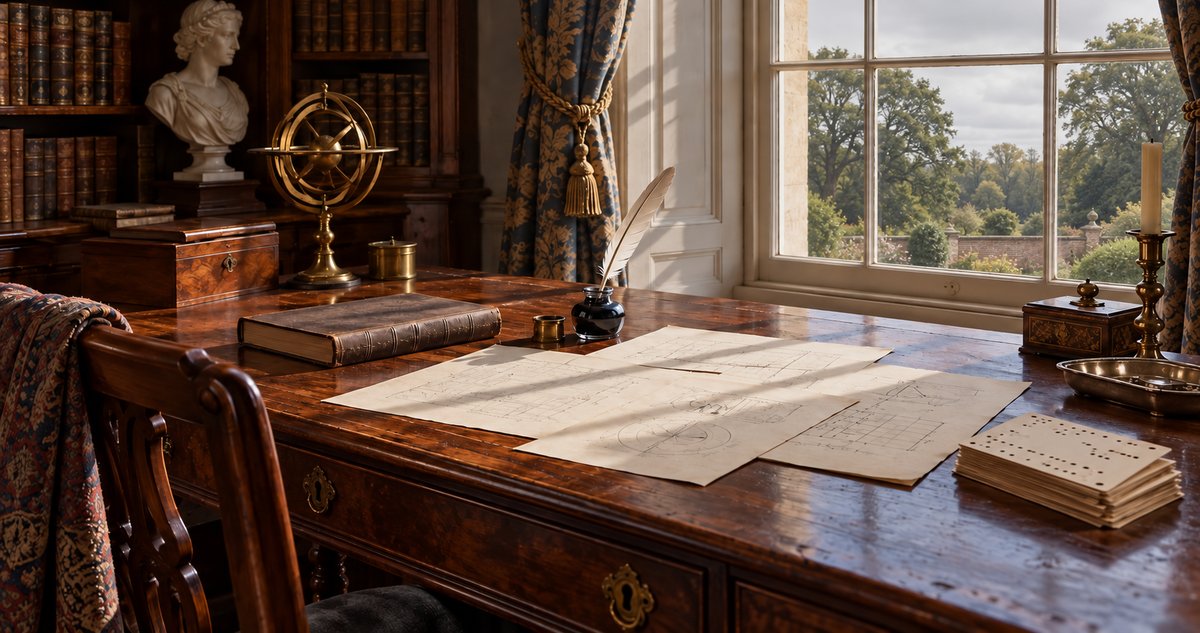
1869: Mendeleev Makes Room for Elements Still Unknown
Gaps in an early periodic table turned an arrangement of known elements into a tool for predictions.
Estimated CEFR reading level: C1. Scientific classification vocabulary, contrasts between predictions and observations, and qualified historical claims. This is an editorial estimate, not an official certification.

Five useful words
British English pronunciation (IPA). Audio uses an available English voice on your device.
classify /ˈklæsɪfaɪ/
verbTo arrange things into groups using shared features.
Scientists classify materials to compare them.
recurring /rɪˈkɜːrɪŋ/
adjectiveAppearing again in a pattern.
The arrangement showed recurring properties.
property /ˈprɒpəti/
nounA characteristic of a substance or object.
The researcher compared chemical properties.
prediction /prɪˈdɪkʃən/
nounA statement about what an investigation may find.
The prediction could be checked against later discoveries.
framework /ˈfreɪmwɜːk/
nounA structure for organising ideas or evidence.
New evidence helped revise the framework.
The story
An arrangement with a purpose
In 1869, Dmitri Mendeleev published an arrangement of the chemical elements based on repeating properties and atomic weights. He was working on a chemistry textbook, seeking a system that could make known elements easier to understand. His early table looked different from the familiar classroom version used today.
Mendeleev needed more than a list of names in boxes. His classification had to show how elements were related through their chemical properties. By making recurring patterns visible, the arrangement could help chemists identify which elements belonged together and recognise where their knowledge might still be incomplete.
Why the gaps mattered
Mendeleev left gaps for undiscovered elements and predicted properties that those elements should have. Later discoveries, including gallium in 1875, scandium in 1879 and germanium in 1886, supported several predictions. The gaps therefore represented claims that could be tested, rather than empty spaces awaiting arbitrary decoration.
Imagine a library series with numbered volumes and one missing number. You might expect a book to fill that gap. But predicting its subject as well as its number would give you a much more precise claim to check. Mendeleev's predictions similarly went beyond suggesting that something was missing.
One name within a wider history
Other chemists had investigated patterns before Mendeleev, and Julius Lothar Meyer developed a related system independently. The Science History Institute links both men's work to efforts to clarify atomic weights and organise chemistry for teaching. A famous name can identify a milestone without explaining every contribution that made it possible.
The Royal Society of Chemistry also distinguishes historical ordering by atomic mass from modern ordering by atomic number, the number of protons in an atom's nucleus. Mendeleev did not possess the later explanation of atomic structure. Recognising that limitation prevents us from attributing current knowledge to an earlier scientist.
A system that could change
A successful prediction supports part of a framework; it does not make every detail permanently correct. The periodic table continued developing as measurements and explanations improved. Revising a system can strengthen its usefulness rather than erase its historical significance.
The gaps help explain why Mendeleev's classification mattered: they showed chemists where to investigate next. His table organised existing knowledge while making specific predictions about elements still unknown. In this interpretation, a system becomes especially useful when it makes uncertainty visible and gives researchers a clear way to explore it.
Milestones in context
- 1869Mendeleev publishes an early periodic arrangement.
- 1875Gallium is discovered.
- 1879Scandium is discovered.
- 1886Germanium is discovered.
Original explanatory timeline based on the sources below, not to scale.
Three questions
Try answering before you open the answer. You can use your own words.
- Why were the gaps more useful than ordinary empty spaces?
Show answer
They were linked to predicted properties of undiscovered elements, so later discoveries could test the proposals.
- Why does the article mention Lothar Meyer?
Show answer
He developed a related system independently, showing that the history includes contributions beyond one famous name.
- What separates modern ordering from the historical arrangement?
Show answer
Modern tables use atomic number, the number of protons. Early arrangements relied on atomic weights and repeating chemical properties.
Let's talk about it
A few ideas to chat about - pick any that interest you.
- Have you ever spotted a missing piece that helped you understand a bigger pattern?
- Would you find predicting an unknown element more exciting than discovering one?
- How do you feel when a familiar scientific explanation is revised?
- What would make an empty space in a scientific chart feel like a useful clue rather than a mistake?
- Would you rather hear about a prediction that worked or one that helped a scientist notice a problem?
Practise a useful pattern
Use rather than and without to qualify historical claims: "A famous name can mark a milestone without explaining every contribution." Write two similar qualifications about a discovery you know.
Frequently asked questions
Did Mendeleev's table already have the modern layout and explanation?
No. It was based on atomic weights and repeating properties; the modern ordering uses atomic number.
Was Mendeleev the only chemist seeking a periodic system?
No. Earlier investigators and Julius Lothar Meyer also contributed to the history of classification.
Sources and editorial notes
Original learning article by Poly-Puff, written from the factual sources below. Sources checked on 12 October 2026. The artwork and learning activities were created for this article.
1869 marks the early table's publication; it does not date the modern atomic-number explanation. The library comparison and interpretation of classification are original explanatory writing. The hero does not reproduce a factual periodic table.