Chemistry Nobel 2026: Why a Molecule's Mirror Image Matters
Henri B. Kagan and Kenso Soai receive recognition for discoveries about reactions that favour one molecular form.
Estimated CEFR reading level: B2. A familiar comparison introduces an abstract scientific distinction, with cause-and-effect explanations and qualified claims. This is an editorial estimate, not an official certification.
Five useful words
British English pronunciation (IPA). Audio uses an available English voice on your device.
molecule /ˈmɒlɪkjuːl/
nounA group of atoms joined together.
A molecule can have a particular shape.
mirror image /ˈmɪrər ˌɪmɪdʒ/
noun phraseA reversed form like a reflection.
The two models are mirror images.
imbalance /ɪmˈbæləns/
nounA situation in which two amounts are unequal.
The reaction increased the imbalance.
amplify /ˈæmplɪfaɪ/
verbTo make something larger or stronger.
A small difference can amplify during a process.
reaction /riˈækʃən/
nounA process in which substances change chemically.
The reaction produced a new substance.
The story
A question of shape
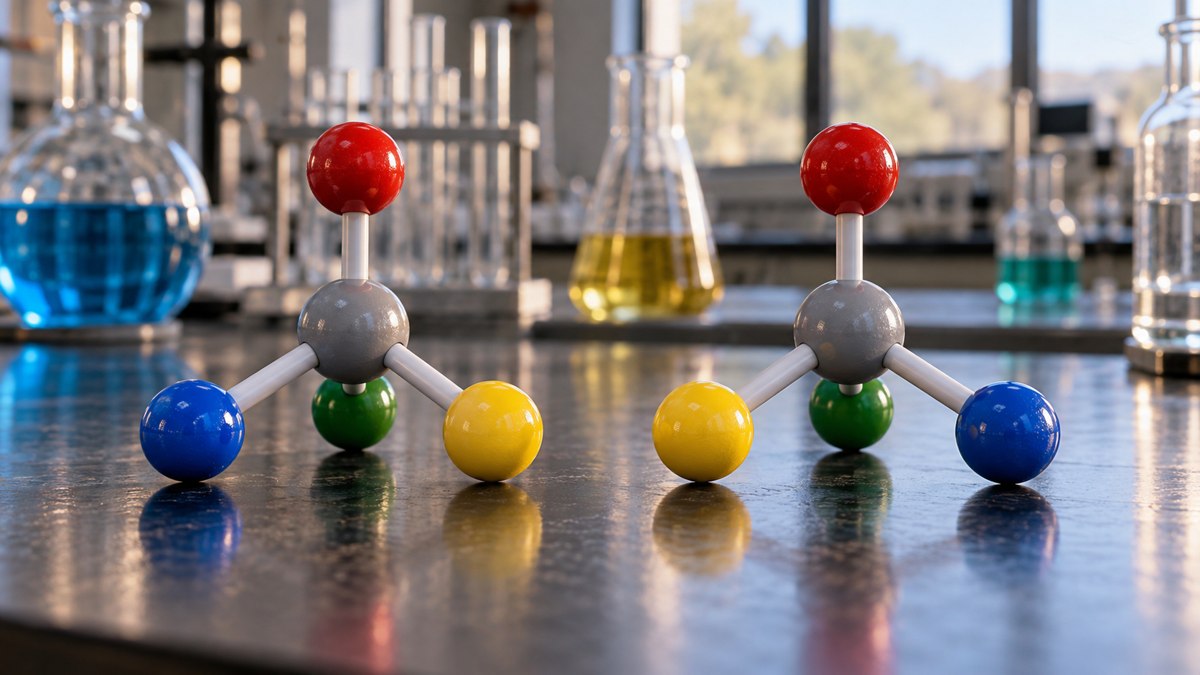
Your hands look similar, but a left glove does not fit your right hand in the same way. Some molecules also have two mirror-image forms. Their atoms are connected in the same order, yet their three-dimensional arrangements differ.
The 2026 Nobel Prize in Chemistry recognises Henri B. Kagan and Kenso Soai for discoveries that help chemists favour one of these forms. The Royal Swedish Academy of Sciences describes how Kagan studied reactions that amplify an imbalance between mirror images. Soai developed a reaction in which the product helps make more of itself, increasing the preference for one form.
Why the difference matters
Shape matters when molecules interact with living systems. Two mirror forms can have different effects, so controlling which one is produced is useful when developing medicines and other materials.
The prize celebrates ways to understand and control chemical reactions. It does not announce a single new medicine. The hand comparison makes the central idea easier to picture, although real molecules are much smaller and their behaviour requires experiments to establish.
Three questions
Try answering before you open the answer. You can use your own words.
- Who receives the chemistry prize?
Show answer
Henri B. Kagan and Kenso Soai.
- Why can mirror-image molecules behave differently?
Show answer
Their three-dimensional arrangements differ, affecting how they interact with living systems.
- Does the prize announce one new medicine?
Show answer
No. It recognises discoveries about chemical reactions.
Let's talk about it
A few ideas to chat about - pick any that interest you.
- What everyday comparison makes a difficult idea clearer for you?
- Would you enjoy building molecular models?
- What surprises you about the importance of shape?
- Would you enjoy an exhibition where you could handle models instead of only reading explanations?
- What would you be curious to ask a chemist about two molecules that look almost the same?
Practise a useful pattern
Use although to connect a similarity with a difference: Although the forms contain the same atoms, their arrangements differ. Write another comparison using although.
Frequently asked questions
Who won the 2026 chemistry Nobel?
Henri B. Kagan and Kenso Soai.
Are mirror-image molecules always interchangeable?
No. Their different shapes can produce different interactions.
Sources and editorial notes
Original learning article by Poly-Puff, written from the factual sources below. Sources checked on 16 October 2026. The artwork and learning activities were created for this article.
The Academy's Swedish explanation was checked directly and the laureate register confirms both names. This original English summary uses a simplified hand comparison; it makes no treatment recommendations or claims about a specific drug. The Nobel Foundation press-release URL could not be retrieved during research.