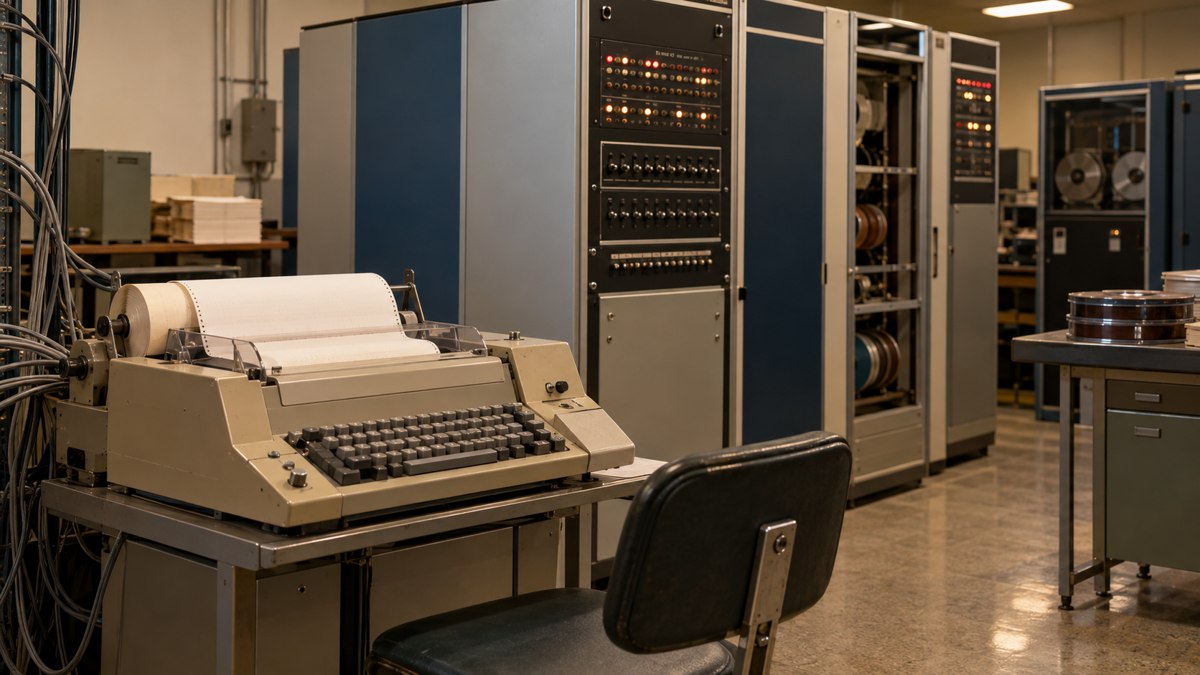
1901: Marconi Listens for a Signal Across the Atlantic
Three faint dots became a famous moment in wireless history. Marconi's experiment also shows why a promising result needs stronger evidence and further work.
Estimated CEFR reading level: B2. Technical vocabulary explained in context, past-tense narration and qualified claims about evidence. This is an editorial estimate, not an official certification.
Five useful words
British English pronunciation (IPA). Audio uses an available English voice on your device.
wireless /ˈwaɪələs/
adjectiveSending information without a connecting wire between the places involved.
Wireless communication helped ships exchange messages.
transmitter /trænzˈmɪtə/
nounEquipment that sends out a signal.
The transmitter was on the other side of the ocean.
receiver /rɪˈsiːvə/
nounEquipment that picks up a signal.
The receiver helped them listen for a message.
faint /feɪnt/
adjectiveDifficult to hear or see clearly.
They listened carefully for a faint sound.
evidence /ˈevɪdəns/
nounInformation that supports or challenges a claim.
A recorded result would provide stronger evidence.
The story
Listening across an ocean
On 12 December 1901, Guglielmo Marconi and his assistant George Kemp reported hearing a radio signal in Newfoundland. It had been sent from Poldhu in Cornwall, England. The message was three dots: the letter S in Morse code.
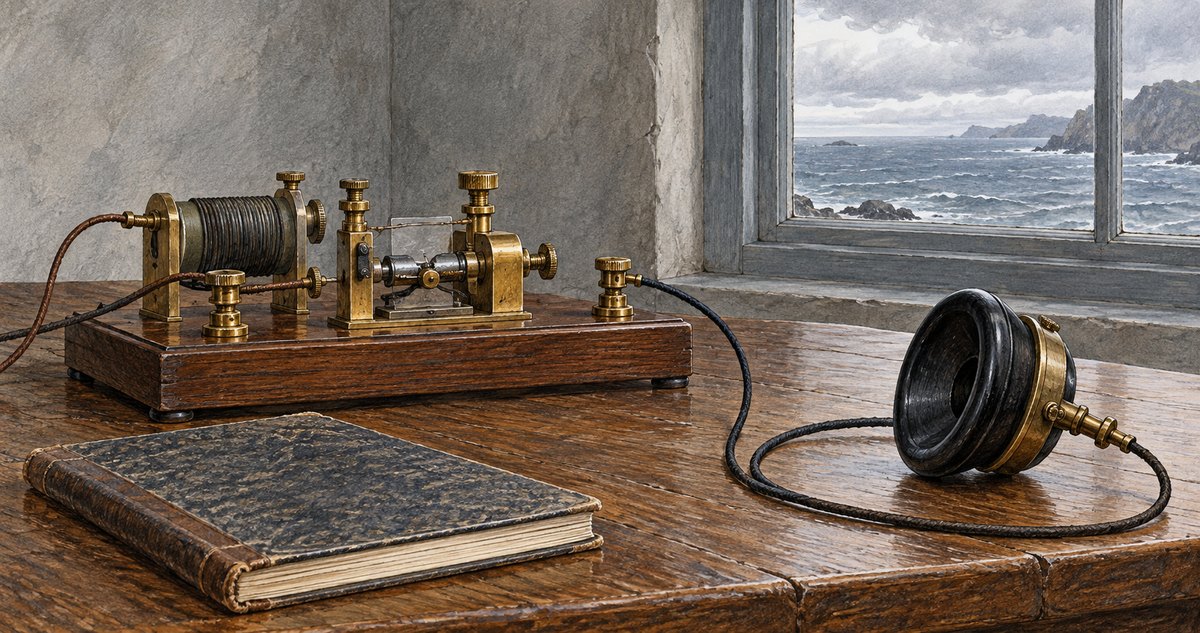
A kite lifted the receiving aerial. Marconi's team listened through a telephone receiver connected to sensitive equipment. The experiment challenged doubts about whether radio signals could travel across the Atlantic.
A milestone with limits
However, the faint signal was not recorded on paper tape. That made the claim harder to demonstrate to people who had not heard it. Later long-distance trials supplied stronger evidence that wireless communication could work over the ocean.
The 1901 experiment was not a spoken conversation, a music broadcast or a regular public service. Sending a brief agreed signal was different from reliably exchanging complete messages.
Marconi's trial showed the possibility of sending a radio signal across the Atlantic, but a dependable service required more work. Later experiments, better equipment and skilled operators helped develop communication between ships and shore. The three dots were an important step towards useful networks, rather than a complete communication system.
Three questions
Try answering before you open the answer. You can use your own words.
- What did the three dots represent?
Show answer
They represented the letter S in Morse code.
- Why was the 1901 claim harder to demonstrate?
Show answer
The faint signal was heard but was not recorded on paper tape.
- How did the trial differ from a public radio service?
Show answer
It used a brief agreed signal, rather than reliably exchanging complete messages or broadcasting speech and music.
Let's talk about it
A few ideas to chat about - pick any that interest you.
- Would you have found three faint dots convincing if you had heard them yourself?
- Which invention has changed how you communicate most during your lifetime?
- What do you enjoy about stories of an invention's first successful test?
- Would you enjoy trying to send a short message using Morse code?
- What would you want to see happen again before trusting an exciting first test?
Practise a useful pattern
Compare "They proved it" with "They reported hearing it". The second describes a claim without making its certainty stronger. Write two pairs of sentences using reported, suggested or demonstrated, and explain how your verb changes the strength of the claim.
Frequently asked questions
When was Marconi's famous Atlantic experiment?
It took place on 12 December 1901.
Was the first signal a spoken message?
No. It was the Morse-code letter S, represented by three dots.
Sources and editorial notes
Original learning article by Poly-Puff, written from the factual sources below. Sources checked on 12 October 2026. The artwork and learning activities were created for this article.
The account distinguishes reported reception in 1901 from later trials and working services. Oxford's museum explains the lack of a paper-tape record. No exact frequency, apparatus replica or complete explanation of radio propagation is claimed here.