1971: How the @ Sign Found Its Place in Email
Ray Tomlinson connected a user with a computer address using a familiar keyboard symbol.
Estimated CEFR reading level: B2. Past-tense narrative and comparison distinguish a network innovation from earlier same-computer messages and uncertain recollections. This is an editorial estimate, not an official certification.
Five useful words
British English pronunciation (IPA). Audio uses an available English voice on your device.
network /ˈnetwɜːk/
nounConnected computers that can exchange information.
The message travelled across a network.
destination /ˌdestɪˈneɪʃən/
nounThe place something is being sent to.
The address identified the destination computer.
username /ˈjuːzəneɪm/
nounA name identifying a person in a computer system.
The username came before the symbol.
contribution /ˌkɒntrɪˈbjuːʃən/
nounSomething that helps produce a result.
His contribution changed computer mail.
recollection /ˌrekəˈlekʃən/
nounA memory of something from the past.
His recollection did not include the exact words.
The story
A message between machines
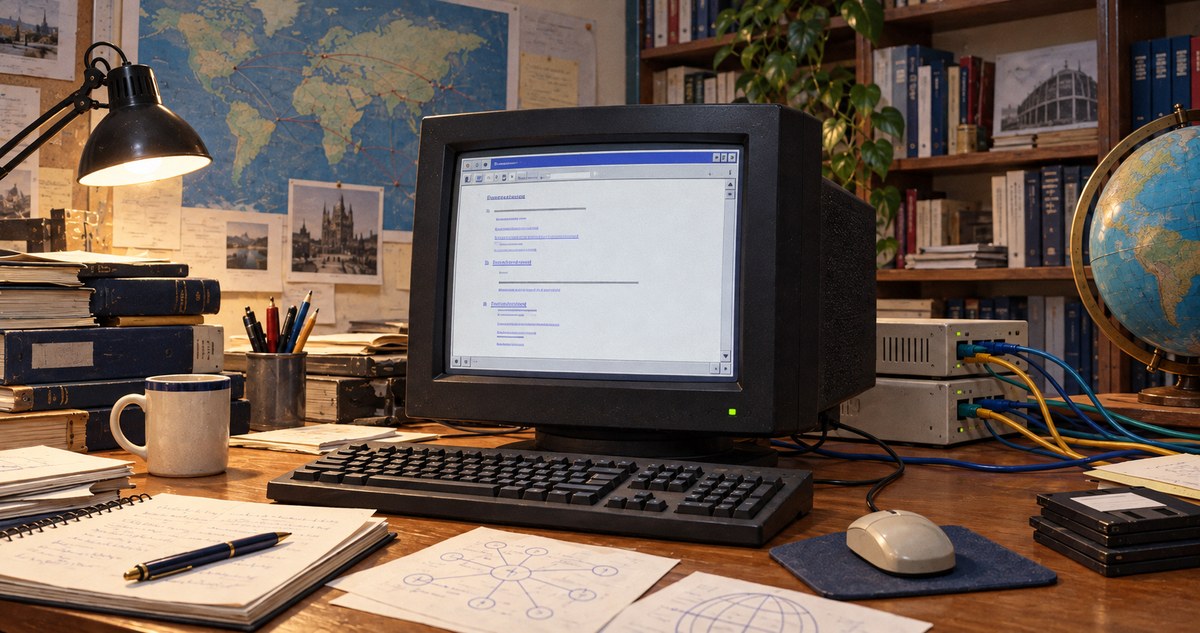
In 1971, engineer Ray Tomlinson developed a way to send electronic messages between computers on ARPANET, an early research network. He worked at Bolt Beranek and Newman, usually called BBN. His experiment helped turn computer mail into communication across a network.
People could already leave messages for other users of the same computer. Tomlinson's contribution was to make a message travel to another machine. An address therefore needed to identify both the person and the destination computer.
A useful symbol
Tomlinson chose @ to separate those two parts. The symbol was available on the keyboard and was unlikely to be confused with a person's username. Read as 'at', it also suggested where the user could be reached.
The first test message was not a carefully prepared speech for history. Tomlinson later said he could not remember its exact contents. The lasting detail was the address format, not a famous first sentence. That distinction makes the story less dramatic, but more accurate.
Three questions
Try answering before you open the answer. You can use your own words.
- What could earlier same-computer mail do?
Show answer
It let users leave messages for others on the same computer.
- What did @ separate?
Show answer
The username and the destination computer.
- Do we know the exact first message from Tomlinson's memory?
Show answer
No. He said he could not remember its exact contents.
Let's talk about it
A few ideas to chat about - pick any that interest you.
- Which keyboard symbol do you use most often?
- Do you prefer email or another kind of message?
- What ordinary digital detail would you like to know the history of?
- How do you feel about old digital messages being saved as part of history?
- If you could send one email to a computer user from the 1970s, what would you want to ask?
Practise a useful pattern
Use could already and made it possible to to distinguish earlier abilities from a new contribution. Write two sentences comparing same-computer mail with network mail.
Frequently asked questions
Did Tomlinson invent every form of electronic messaging?
No. Same-computer messaging already existed; his milestone concerned network email.
Is the exact first test message known?
Tomlinson said he did not remember its exact contents.
Sources and editorial notes
Original learning article by Poly-Puff, written from the factual sources below. Sources checked on 16 October 2026. The artwork and learning activities were created for this article.
The year is known, but no exact first-message day or wording is invented. Network email is distinguished from earlier same-machine mail. The interview account is hosted by the Internet Hall of Fame and credited there to Wired; both this account and the institutional profile were read.