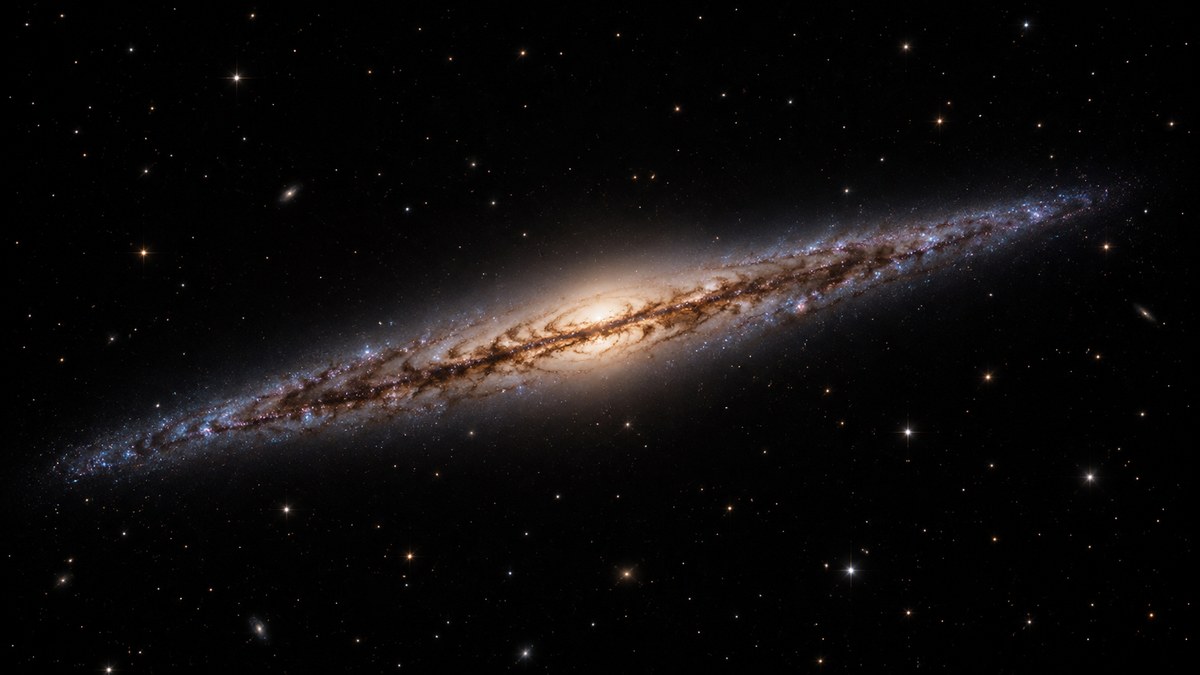
Hubble's NGC 1827 Image: Why the Viewing Angle Matters
A thin streak of light is a galaxy seen from the side. Hubble reveals details that a face-on view would hide.
Estimated CEFR reading level: B2. Spatial comparisons, cautious scientific claims and a distinction between observation and interpretation support the B2 estimate. This is an editorial estimate, not an official certification.
Five useful words
British English pronunciation (IPA). Audio uses an available English voice on your device.
edge-on /ˌedʒ ˈɒn/
adjectiveSeen from the side, with the narrow edge facing the viewer.
The plate looks narrow when viewed edge-on.
galaxy /ˈɡæləksi/
nounA huge system of stars, gas and dust held together by gravity.
Our Sun belongs to a galaxy called the Milky Way.
dust lane /ˈdʌst leɪn/
nounA dark-looking band of dust that blocks some light from behind it.
A dust lane crosses the bright disk.
foreground /ˈfɔːɡraʊnd/
nounThe part of a view closer to the observer.
The foreground star is much nearer than the galaxy.
light-year /ˈlaɪt jɪə/
nounThe distance light travels in one year.
A light-year is a distance, not a period of time.
The story
Imagine looking at a dinner plate from the side. Its broad surface becomes a narrow shape. A similar change of viewpoint helps explain a Hubble Space Telescope image published by NASA on 16 October 2026. It shows NGC 1827, a spiral galaxy seen nearly edge-on.
The galaxy lies roughly 37 million light-years away, in the constellation Columba. A light-year measures distance: the distance light travels in one year. In the image, dark lanes of dust cross the bright disk. Blue regions along it are places where new stars are likely forming.
One bright point near the galaxy's centre can be misleading. It is a foreground star, between Earth and the distant galaxy. Its cross-shaped spikes come from the telescope's structure, rather than the star's actual shape.
The image is striking, but it also invites careful reading. Objects that appear close together in a photograph may be separated by enormous distances. Brightness, colour and position offer clues; they do not tell the whole story on their own.
Three questions
Try answering before you open the answer. You can use your own words.
- Why does the article compare the galaxy to a plate?
Show answer
The comparison explains how a broad disk looks narrow when seen from the side.
- What does a light-year measure?
Show answer
Distance: how far light travels in one year.
- Why should we avoid assuming the bright star belongs to NGC 1827?
Show answer
It is a foreground star, so its apparent position does not mean it is inside the distant galaxy.
Let's talk about it
A few ideas to chat about - pick any that interest you.
- What catches your eye first in a picture of space?
- Have you ever seen a familiar object look surprising from a new angle?
- Would you enjoy visiting an observatory at night?
- Do space photographs make distances easier or harder for you to imagine?
- Which would you like to understand better: stars, galaxies or telescopes?
Practise a useful pattern
Use appear to when describing an impression that may need checking. Write one sentence about how an object looks.
Example: The star appears to sit beside the galaxy, but it is much closer to us.
Frequently asked questions
What is an edge-on galaxy?
It is a galaxy whose disk is viewed nearly from the side, so it appears narrow.
Is a light-year a unit of time?
No. It is the distance light travels in one year.
Sources and editorial notes
Original learning article by Poly-Puff, written from the factual sources below. Sources checked on 18 October 2026. The artwork and learning activities were created for this article.
The release page is dated 16 October 2026. The NASA news listing also contains a conflicting September date; this lesson follows the dated release itself. No observation date is inferred from the publication date. Star formation is described as likely, and the generated hero is not telescope data.