1666: Why the Great Fire of London Spread
A bakery fire became a city disaster because vulnerable buildings, dry weather, wind and limited firefighting capacity reinforced one another.
Estimated CEFR reading level: C2. A compact causal argument using counterfactuals, qualified comparisons and distinctions between evidence and hindsight. This is an editorial estimate, not an official certification.
Five useful words
British English pronunciation (IPA). Audio uses an available English voice on your device.
conflagration /ˌkɒnfləˈɡreɪʃən/
nounA large destructive fire.
A small blaze became a conflagration.
combustible /kəmˈbʌstəbəl/
adjectiveAble to catch fire and burn.
Combustible materials increased the danger.
firebreak /ˈfaɪəbreɪk/
nounA gap that helps stop a fire spreading.
Demolition created a firebreak.
hindsight /ˈhaɪndsaɪt/
nounUnderstanding gained after an event.
Hindsight makes the decision seem easier.
constraint /kənˈstreɪnt/
nounA limit on what can be done.
Property boundaries were a constraint on rebuilding.
The story
Where did the fire begin?
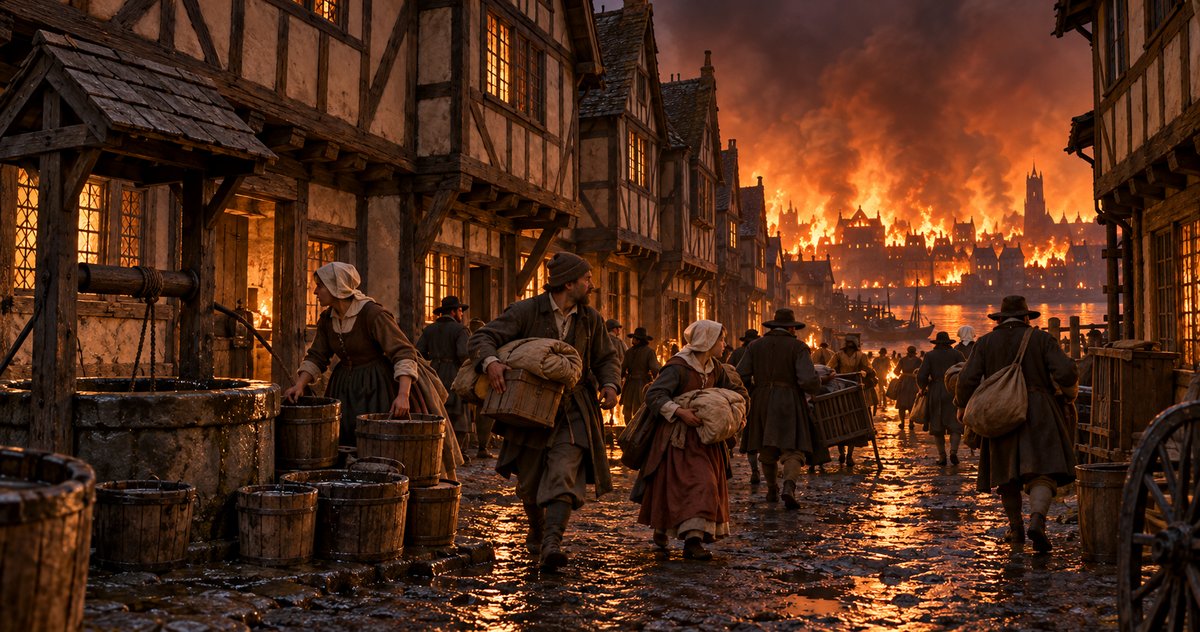
The Great Fire of London began in a bakery on Pudding Lane early on 2 September 1666. Naming the starting point, however, explains only where the disaster originated. To understand why it spread, we need to examine the conditions surrounding that first fire: densely packed buildings, combustible materials, a dry summer and strong winds.
Much of the City of London contained narrow streets and timber houses with upper floors extending outwards. Homes and businesses often occupied the same buildings. This arrangement brought people, goods and fuel close together. A city can therefore be vulnerable before anyone strikes a spark; the layout helps determine whether an ordinary incident remains local.
Why was the response difficult?
London did not have a modern fire brigade. People used buckets, hand-operated equipment and firehooks, which could pull parts of buildings down. Demolishing houses could create gaps that interrupted the fire's path. Yet destroying property to save neighbouring streets was a difficult decision, especially before the scale of the danger became clear.
Judging the response requires considering the options Londoners actually had. They lacked the equipment and institutions of a modern fire service. Water could help with small fires, but containing a wind-driven conflagration required more disruptive measures, including demolition. Those interventions took considerable labour and offered no certainty of success, even when they were the best available choices.
How did the burning end?
As the fire intensified, gunpowder was used to destroy buildings and create wider firebreaks. A change in wind also helped. The museum partnership's timeline describes most remaining fires being extinguished on 5 September, followed by further outbreaks and a final isolated fire on 6 September. A single end date compresses a more uneven process.
The city was not saved by one action alone. Weather, demolition and sustained firefighting effort worked together. Had strong winds continued, some interventions might have been less effective. That suggestion is a counterfactual: it considers an alternative course of events. It does not claim that we can calculate precisely what would have happened under different conditions.
Did rebuilding remove the danger?
Rebuilding offered an opportunity to change the city. Rules required new houses to be faced with brick or stone, and recovery continued over many years. Although ambitious redesigns were proposed, the eventual street layout changed less dramatically. The museum account distinguishes proposed plans from what was actually implemented.
Rebuilding exposed the gap between proposing reform and carrying it out. Safer materials could reduce vulnerability, but practical constraints remained and London continued to experience fires. Lasting improvement depended on several kinds of work: recognising hazards, organising a response and maintaining protection after public attention moved elsewhere. Changing one condition could help without resolving every source of risk.
The same distinction helps us read accounts of recovery. A new regulation does not establish that people followed it, and restoring one landmark does not show that an entire neighbourhood recovered. Understanding renewal requires looking beyond a memorable image to the slower work of rebuilding, implementing rules and sustaining improvements.
Three questions
Try answering before you open the answer. You can use your own words.
- Why is the bakery an incomplete explanation?
Show answer
It identifies the starting point, but buildings, materials, weather and response capacity explain the spread.
- What is the counterfactual in the article?
Show answer
The suggestion that interventions might have been less effective if the wind had remained strong. It is qualified reasoning, not an observed result.
- Why should readers distinguish rebuilding plans from implementation?
Show answer
A proposal does not establish what was built; the realised layout changed less dramatically than ambitious plans suggested.
Let's talk about it
A few ideas to chat about - pick any that interest you.
- Have you ever reconsidered a historical decision after learning what options people had?
- How would you feel about sacrificing one building to protect a neighbourhood?
- What might help a city keep improving safety once a disaster is no longer in the news?
- What would you want a rebuilding project to preserve about the life of an old neighbourhood?
- How do you react when a familiar disaster story turns out to have a more complicated explanation?
Cautious counterfactuals
Use Had + subject + past participle and might have: "Had the wind remained strong, the response might have been less effective." Explain why might matters.
Frequently asked questions
How did the Great Fire of London start?
It began at a bakery on Pudding Lane early on 2 September 1666. The precise ignition mechanism is not asserted here.
Was the whole city immediately rebuilt to one new plan?
No. Proposed redesigns differed from the more limited changes implemented, and rebuilding took years.
Sources and editorial notes
Original learning article by Poly-Puff, written from the factual sources below. Sources checked on 10 October 2026. The artwork and learning activities were created for this article.
The main fire is usually dated 2-5 September 1666; the museum timeline also records later outbreaks through 6 September. This account does not claim an exact death toll or ignition mechanism. Counterfactual reasoning is explicitly qualified. No modern firefighting advice is implied.