1903: Twelve Seconds That Changed Flight
Two brothers tested a flying machine after years of learning how to control it.
Estimated CEFR reading level: A2. A short chronological story with mostly familiar vocabulary and simple past-tense sentences. Technical words are explained below. This is an editorial estimate, not an official certification.
Five useful words
British English pronunciation (IPA). Audio uses an available English voice on your device.
flight /flaɪt/
nounA journey through the air.
Our flight to the island took one hour.
glider /ˈɡlaɪdə/
nounAn aircraft that can fly without an engine.
The glider moved quietly above the field.
control /kənˈtrəʊl/
verbTo make something move or work in the way you want.
She learnt to control the small boat.
engine /ˈendʒɪn/
nounA machine that provides power to move something.
The driver started the engine.
attempt /əˈtempt/
nounAn effort to do something.
My first attempt was difficult, but I tried again.
The story
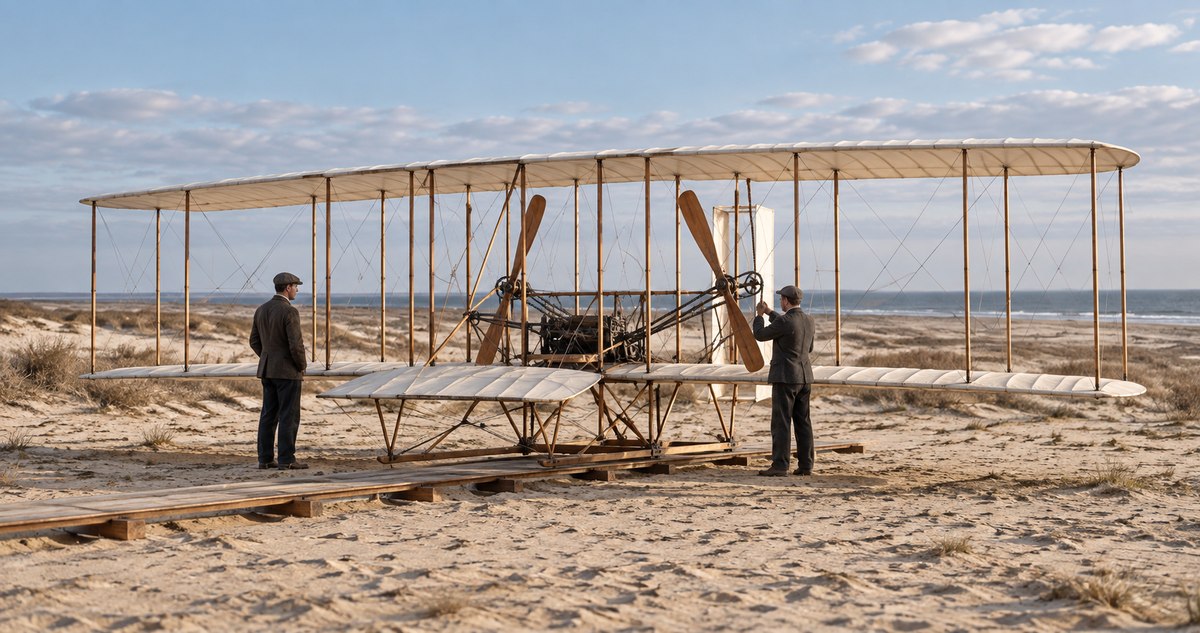
On 17 December 1903, Orville Wright flew the Flyer for twelve seconds in North Carolina, USA. His brother Wilbur helped beside the machine. The flight covered about 37 metres.
The brothers had worked with bicycles. Before trying powered flight, they tested gliders and built a wind tunnel to study wing shapes. They needed to learn how to control the aircraft. An engine could move it, but the pilot also had to guide it.
They made four flights that day. Wilbur's last lasted 59 seconds. Later, a strong gust damaged the Flyer.
People had flown in balloons and gliders before. The Wrights showed controlled flight in a powered plane. Their famous moment followed years of work and unsuccessful attempts. A short flight can tell a long story about testing, learning and trying again.
A short road to the first powered flights
- 1899The brothers begin serious work on flight.
- 1901A wind tunnel helps them test wing designs.
- 17 December 1903They make four powered flights in North Carolina.
An original timeline based on National Park Service accounts. It shows selected steps, not every experiment.
Three questions
Try answering before you open the answer. You can use your own words.
- Who piloted the first successful flight on 17 December?
Show answer
Orville Wright.
- What did the brothers test before powered flight?
Show answer
Gliders. They also used a wind tunnel to test wing designs.
- How many flights did they make that day?
Show answer
Four flights.
Let's talk about it
Here are some ideas for a chat. Choose any you like.
- What have you learnt by trying several times?
- Would you like to try a glider flight?
- Who do you like working with when a problem is difficult?
- What would you like to ask the brothers about their first flight?
- Would you enjoy building and testing a model plane?
Putting past events in order
Use first, then and later with the simple past: "First, they tested gliders. Then, they built a powered machine." Write three short sentences about something you learnt to do.
Sources and context
An original learning article by Poly-Puff, written from the factual sources below. Sources checked on 5 October 2026. The artwork and learning activities were created for this article.