1893: New Zealand Women Win a Voice at the Ballot Box
Petitions and political campaigning brought a landmark voting change, while other barriers remained.
Estimated CEFR reading level: B2. Qualification, cause and effect, and topic-specific vocabulary support the B2 estimate. This is an editorial estimate, not an official certification.
Five useful words
British English pronunciation (IPA). Audio uses an available English voice on your device.
petition /pəˈtɪʃən/
nounA formal request supported by people's signatures.
Neighbours signed a petition for a new crossing.
representation /ˌreprɪzenˈteɪʃən/
nounHaving someone speak or act for a group in decision-making.
The campaign called for fair representation.
candidate /ˈkændɪdət/
nounSomeone seeking election to a position.
Each candidate spoke at the meeting.
milestone /ˈmaɪlstəʊn/
nounAn important point in a longer development.
The vote was a milestone in the campaign.
collective /kəˈlektɪv/
adjectiveDone or shared by a group.
The result came from collective effort.
The story
On 19 September 1893, New Zealand's governor signed an Electoral Act extending parliamentary voting rights to women. New Zealand became the first self-governing country to make this change.
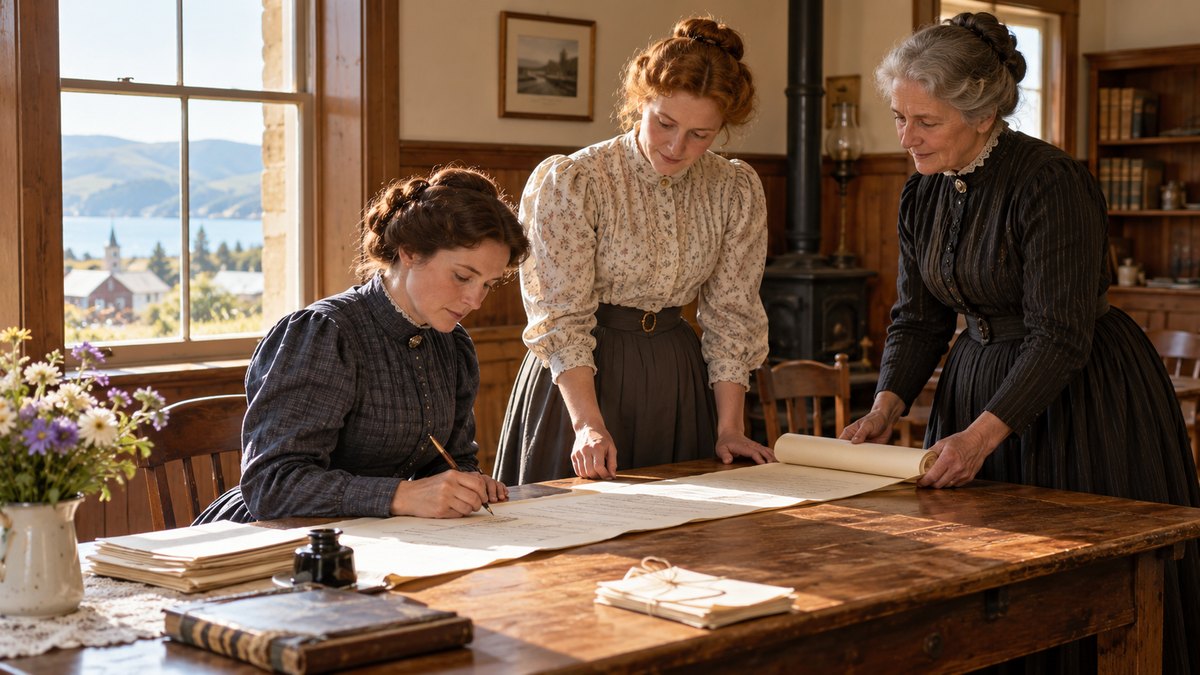
The result followed years of campaigning. Kate Sheppard and many other organisers gathered signatures on petitions and pressed politicians to act. Their work connected local conversations with a national demand for representation.
The law covered women aged 21 and over who met its British-subject requirement, including Māori women. That requirement still excluded some women, so the achievement should not be described as removing every barrier.
Voting also differed from becoming a candidate. Women could vote in parliamentary elections in 1893, but they did not gain the right to stand for Parliament until 1919.
The milestone therefore had both power and limits. It changed who could help choose representatives, while leaving further political rights to be won. A single date marks the law; a longer history explains the collective work behind it.
A short timeline
- 1891-1893
Campaigners organise major petitions for women's voting rights.
- 19 September 1893
The Electoral Act becomes law.
- 1919
Women gain the right to stand for Parliament.
Three questions
Try answering before you open the answer. You can use your own words.
- How did campaigners show support for change?
Show answer
They gathered petition signatures and pressed politicians to act.
- Did the 1893 law remove every exclusion?
Show answer
No. Eligibility conditions, including the British-subject requirement, still excluded some women.
- What right came later, in 1919?
Show answer
The right for women to stand for Parliament.
Let's talk about it
A few ideas to chat about - pick any that interest you.
- Have you ever signed a petition about something local?
- Which historical campaign would you like to learn more about?
- What helps a group keep working towards a distant goal?
- How does your community remember important changes?
- Would you rather visit a political history museum or read a campaigner's letters?
Practise a useful pattern
Use while to connect an achievement with a remaining limit. Write a sentence about progress that is incomplete.
Example: While the campaign changed the rules, further work remained.
Frequently asked questions
What changed in New Zealand on 19 September 1893?
An Electoral Act extended parliamentary voting rights to eligible women, including Māori women.
Could women stand for Parliament immediately?
No. That right followed in 1919.
Sources and editorial notes
Original learning article by Poly-Puff, written from the factual sources below. Sources checked on 21 October 2026. The artwork and learning activities were created for this article.
The first-self-governing-country description concerns parliamentary voting rights, not every form of voting everywhere. The reading retains the colonial law's eligibility limits and separates voting, candidacy and later representation.