1783: The Balloon Flight That Let Go of the Ground
Two men rose above Paris in a balloon built by the Montgolfier brothers. Their journey made human flight a public reality, but staying airborne required constant work.
Estimated CEFR reading level: C1. Distinctions between experimental milestones, control and risk, together with an interpretation of public spectacle, support the C1 estimate. This is an editorial estimate, not an official certification.
Five useful words
British English pronunciation (IPA). Audio uses an available English voice on your device.
tether /ˈteðə/
nounA rope or line that holds something to a fixed point.
A tether kept the test balloon attached to the ground.
aeronaut /ˈeərənɔːt/
nounA person who travels in a balloon or airship.
The aeronaut watched the rising embers.
ember /ˈembə/
nounA small piece of wood or coal that remains hot after burning.
An ember threatened the fabric.
sustain /səˈsteɪn/
verbTo keep something continuing or functioning.
Hot air helped sustain the flight.
prestige /preˈstiːʒ/
nounRespect and admiration connected with achievement or status.
The demonstration brought prestige to its supporters.
The story
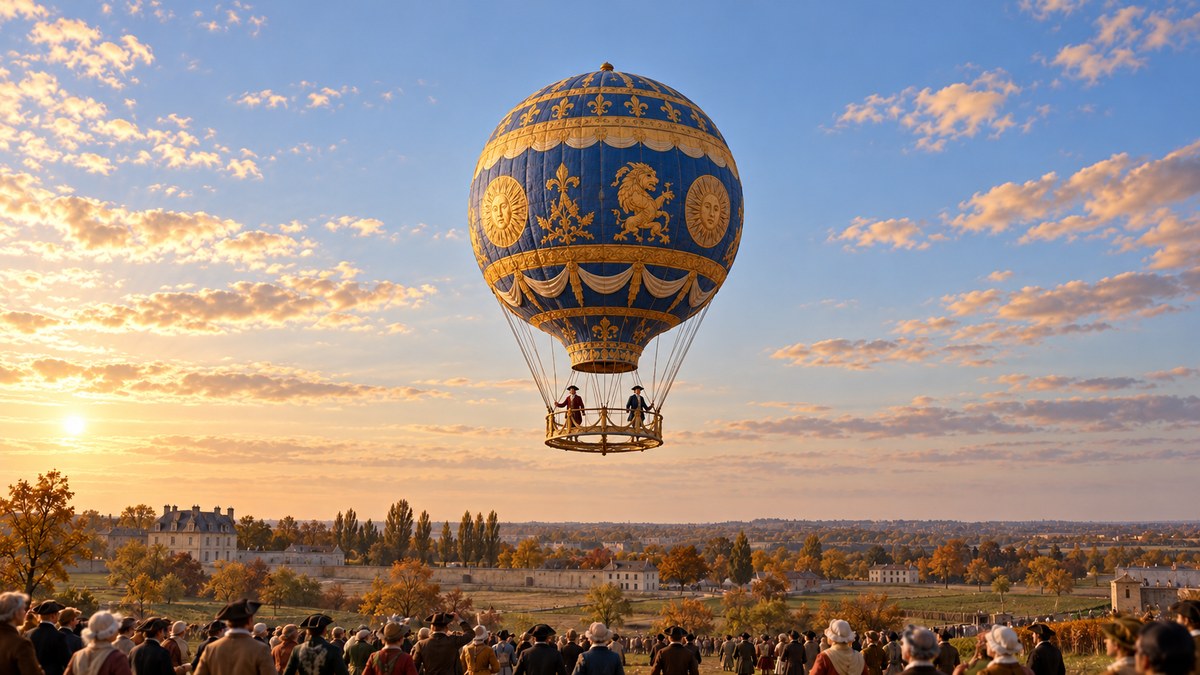
On 21 November 1783, Jean-François Pilâtre de Rozier and François Laurent, the marquis d'Arlandes, lifted off near Paris in a hot-air balloon. This time, no ropes held the craft to the ground. Their journey became the first free balloon flight carrying people, a distinction that matters because earlier experiments had already sent balloons and living passengers into the air.
The balloon was the work of Joseph and Étienne Montgolfier, brothers from a family of paper manufacturers. During 1783, their experiments progressed from a public demonstration at Annonay in June to an extraordinary trial at Versailles in September. The passengers on that occasion were a sheep, a duck and a rooster. They returned safely, providing encouragement for the next stage.
Those separate milestones are easily compressed into a single claim about the first flight. Yet the September demonstration tested an animal-carrying balloon, whereas the November journey carried two people without a tether. Keeping the dates and passengers separate reveals how the achievement developed through successive experiments rather than one isolated moment of inspiration.
The November flight began at the Château de la Muette, on the western outskirts of Paris. According to the Museum of Flight, the aeronauts fed straw into a burner to keep the air hot. They also used wet sponges on poles to extinguish embers inside the balloon. The same fire that sustained the flight therefore created a threat to the fabric surrounding them.
The journey lasted about twenty-five minutes before the balloon landed outside the city. Remaining airborne demanded attention and physical effort. For the passengers, the achievement was not simply a matter of being lifted: it involved managing a fragile craft while its source of lift also exposed it to danger.
The spectacle reached people who never left the ground. Surviving prints and balloon-themed objects in the Science Museum Group's collections show how the invention entered popular culture. The museum also explains how the Versailles setting associated the earlier demonstration with royal prestige. Flight was an engineering experiment, but it could carry a political message as well. Together, the experiments and the images suggest a broader lesson: a technology changes public imagination when people can see it working, even before its practical uses are clear.
A short timeline
- 4 June 1783
The Montgolfiers demonstrate an uncrewed balloon at Annonay.
- 19 September 1783
A sheep, a duck and a rooster fly at Versailles.
- 21 November 1783
Pilâtre de Rozier and d'Arlandes make a free balloon flight near Paris.
Three questions
Try answering before you open the answer. You can use your own words.
- What made the November journey different from the September demonstration?
Show answer
The September balloon carried animals; the November free flight carried two people without a tether.
- Why did the source of lift also create danger?
Show answer
The fire kept the air hot, but its embers could damage the balloon fabric, so the aeronauts had to put them out.
- What supports the interpretation that flight became more than an engineering experiment?
Show answer
The royal setting connected the September demonstration with prestige, while prints and balloon-themed objects show its wider cultural appeal.
Let's talk about it
A few ideas to chat about - pick any that interest you.
- Would you have wanted to watch that first free flight from the ground?
- How do you feel about the risks the two aeronauts accepted?
- Which modern invention has changed what you imagine might be possible?
- What do you make of the connection between a scientific spectacle and royal prestige?
- Would a surviving balloon, a historical print or a personal account most interest you in a museum?
Practise a useful pattern
Use whereas to mark a precise contrast between two events. Write a sentence comparing the September and November milestones.
Example: The September balloon carried animals, whereas the November free flight carried two people.
Frequently asked questions
Who made the first free balloon flight carrying people?
Jean-François Pilâtre de Rozier and François Laurent, the marquis d'Arlandes, made it on 21 November 1783 in a Montgolfier balloon.
Did the Montgolfier balloon carry people at Versailles in September 1783?
That demonstration carried a sheep, a duck and a rooster. The free flight with two human passengers followed in November.
Sources and editorial notes
Original learning article by Poly-Puff, written from the factual sources below. Sources checked on 19 October 2026. The artwork and learning activities were created for this article.
Sources checked on 19 October 2026. The November free human flight is distinguished from the June uncrewed demonstration, September animal flight and earlier tethered tests. The Museum of Flight supplies the launch site, approximate duration and fire-management details. Science Museum Group records corroborate the November date and explain the September spectacle and surviving objects. Versailles supplies the September context. The concluding interpretation is editorial analysis grounded in those records. No exact distance, height or crowd total is asserted because such details vary between accounts.