1829: Louis Braille Shares a Code You Can Read by Touch
Six raised dots helped turn touch into a powerful way to read and write. The idea grew through years of work by a young blind student.
Estimated CEFR reading level: B1. A chronological account, a simple explanation of a code and a contrast between languages and writing systems support the B1 estimate. This is an editorial estimate, not an official certification.
Five useful words
British English pronunciation (IPA). Audio uses an available English voice on your device.
code /kəʊd/
nounA system of signs used to represent information.
The code uses patterns of dots.
raised /reɪzd/
adjectiveStanding above a surface.
Her finger followed the raised dots.
fingertip /ˈfɪŋɡətɪp/
nounThe end of a finger.
The whole cell fits under a fingertip.
pattern /ˈpætn/
nounA particular arrangement of things.
Each pattern has a meaning.
access /ˈækses/
nounThe opportunity to obtain or use something.
The library improves access to books.
The story
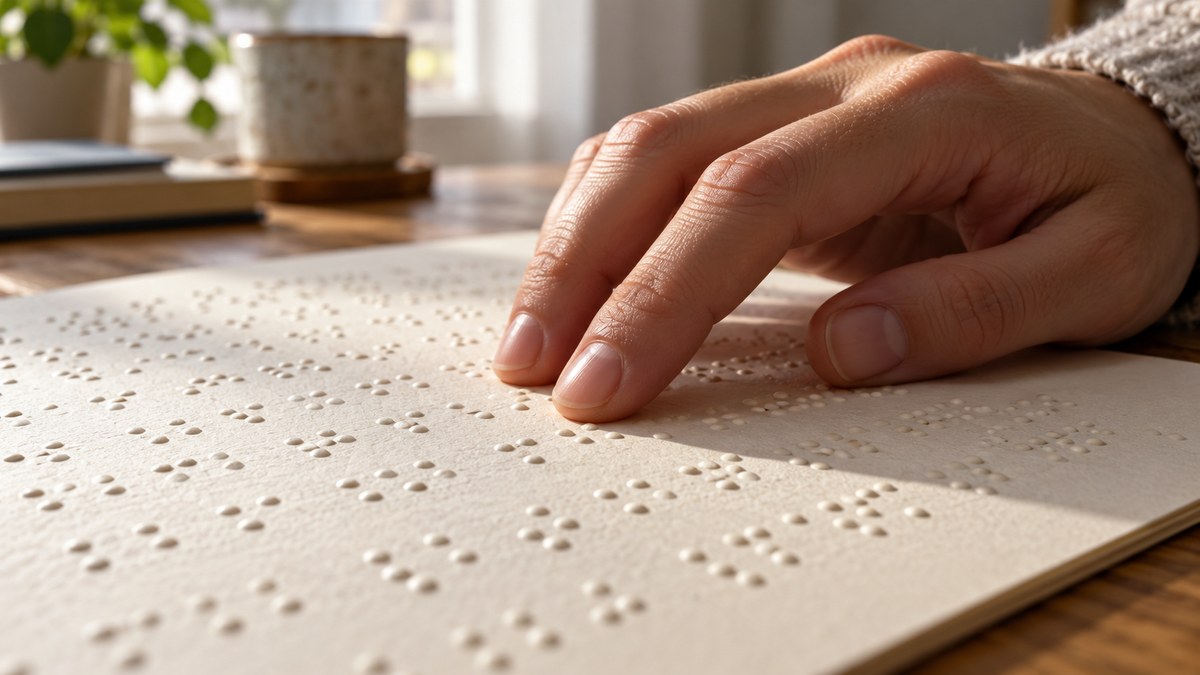
In 1829, Louis Braille published a code that allowed blind people to read and write through touch. He had developed it while studying in Paris. Instead of recognising printed shapes with their eyes, readers could feel patterns of raised dots with a fingertip.
Braille had explored an earlier system created by Charles Barbier. It used twelve dot positions. Braille made the basic cell smaller: two columns, each with three positions. This six-dot design fitted under a fingertip and made the patterns easier to recognise.
Different patterns could represent letters and other signs. His 1829 publication also included a way to write music. Braille was therefore more than a method for receiving information: people could use it to record and share their own ideas.
Braille is a writing system, not a separate language. Different languages use braille codes. The story shows how changing the design of a written page can give more people access to it.
A short timeline
- 1821
Braille encounters Barbier's raised-dot approach in Paris.
- 1824
RNIB dates his six-dot breakthrough to this year.
- 1829
Braille publishes his code, including music notation.
Three questions
Try answering before you open the answer. You can use your own words.
- How do people read braille?
Show answer
They feel patterns of raised dots, usually with their fingertips.
- How did Braille change the basic dot cell?
Show answer
He reduced it from twelve positions to six, arranged in two columns of three.
- What detail shows that the code went beyond ordinary letters?
Show answer
The 1829 publication also included a way to write music.
Let's talk about it
A few ideas to chat about - pick any that interest you.
- What do you find most interesting about the six-dot idea?
- Have you noticed braille on signs, packaging or buttons?
- Would you be interested in learning a few braille letters?
- What makes a library feel welcoming and easy to use?
- Which everyday design would you like to see made more accessible?
Practise a useful pattern
Use instead of to describe an alternative. Write a sentence about two ways to get information.
Example: Readers feel raised dots instead of looking at printed letters.
Frequently asked questions
Is braille a language?
Braille is a tactile reading and writing system. It can represent different languages through their braille codes.
When did Louis Braille publish his code?
He published it in 1829, after years of development. The publication also included a music code.
Sources and editorial notes
Original learning article by Poly-Puff, written from the factual sources below. Sources checked on 19 October 2026. The artwork and learning activities were created for this article.
Sources checked on 19 October 2026. The publication date is distinct from earlier development: RNIB dates the six-dot breakthrough to 1824. The Library of Congress confirms the 1829 publication and music code. The reading does not suggest that adoption was immediate or that every blind person uses braille. The picture is illustrative, so it is not offered as a braille teaching resource.