Green Turtles Show Why Protection Matters
A global assessment reports recovery, while local threats show why conservation must continue.
Estimated CEFR reading level: B1. Connected factual paragraphs with comparisons and cause-and-effect language. Conservation terms are explained below. This is an editorial estimate, not an official certification.
Five useful words
British English pronunciation (IPA). Audio uses an available English voice on your device.
conservation /ˌkɒnsəˈveɪʃən/
nounWork to protect nature and use natural resources carefully.
The island has a conservation programme for local birds.
recover /rɪˈkʌvə/
verbTo return towards a healthier or stronger condition.
The forest is slowly recovering after the fire.
nesting /ˈnestɪŋ/
adjectiveConnected with making or using a place for eggs.
Visitors must stay away from the nesting area.
habitat /ˈhæbɪtæt/
nounThe natural place where an animal or plant lives.
The wetland is an important habitat for frogs.
bycatch /ˈbaɪkætʃ/
nounAnimals caught unintentionally while people fish for something else.
New fishing equipment can help reduce bycatch.
The story
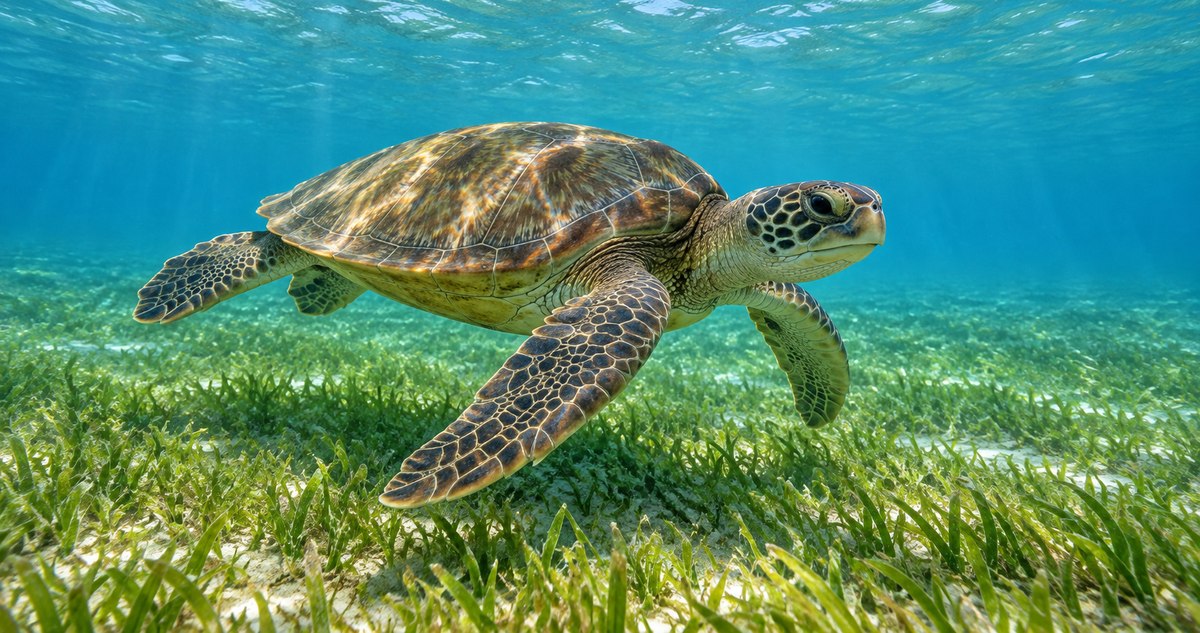
On 10 October 2025, IUCN announced that green sea turtles had moved from Endangered to Least Concern on its global Red List. The specialist assessment found an overall 28% increase in nesting across the sites studied. These records show a trend, not a count of every turtle.
Conservation has helped. People protect nesting females and eggs, limit harmful trade and reduce bycatch: accidental capture in fishing equipment. Turtles cross borders, so protection needs international cooperation.
Global recovery does not mean every local population is safe. Fishing gear, coastal building, artificial lights and climate change still threaten turtles and their habitat.
The Red List describes global extinction risk. Regional assessments and legal protection still matter because an overall improvement can hide local problems. A class average can rise while some students continue to struggle; local turtle populations can also need help despite the worldwide trend. The result supports continuing conservation.
What does a 28% increase mean?
Set the earlier nesting baseline to an index of 100. A reported 28% increase gives an index of 128. These are relative values for the assessed nesting sites, not counts of turtles or nests. The 2025 assessment summarises long-term records, rather than one year of observations.
View the numbers as a table
| Period | Index | Meaning |
|---|---|---|
| Earlier nesting baseline | 100 | Chosen reference value |
| Later nesting level | 128 | 28% above the reference value |
Source: the specialist assessment summary in the 2026 State of the World's Sea Turtles report. Poly-Puff calculated the index from its reported 28% nesting change. The combined trend does not show that every local population recovered equally.
Three questions
Try answering before you open the answer. You can use your own words.
- How did the global Red List category change?
Show answer
It changed from Endangered to Least Concern.
- Name two actions that have helped green turtles.
Show answer
Examples include protecting nesting females and eggs, limiting harmful trade and reducing bycatch.
- Does global recovery mean every local population is safe?
Show answer
No. Local populations can still face serious threats, and regional protections remain relevant.
Let's talk about it
A few ideas to chat about - pick any that interest you.
- Which animal or habitat would you like to learn more about?
- How would you feel about helping protect an animal that also lives in other countries?
- Have you noticed an average that hid important differences?
- Would you enjoy visiting a beach where protecting wildlife changes what visitors can do?
- What would help you stay interested in an animal-protection project over many years?
Adding a useful contrast
However introduces a contrast: "The global population has grown. However, local threats remain." Write two sentences about a positive change that still needs more work.
Sources and context
An original learning article by Poly-Puff, written from the factual sources below. Sources checked on 5 October 2026. The artwork and learning activities were created for this article.