1896: Athens Revives the Olympics and Defines Their Limits
The first modern Olympic Games drew on an ancient past while establishing an event whose traditions would continue to change.
Estimated CEFR reading level: C2. Sustained interpretation of historical continuity, institutional choices and exclusion, with qualified claims and abstract vocabulary. This is an editorial estimate, not an official certification.
Five useful words
British English pronunciation (IPA). Audio uses an available English voice on your device.
revival /rɪˈvaɪvəl/
nounThe return of something after a period of absence or decline.
The revival gave the competition a new form.
antiquity /ænˈtɪkwəti/
nounThe distant past, especially ancient Greek and Roman times.
The ceremony referred to sporting traditions of antiquity.
embody /ɪmˈbɒdi/
verbTo express or represent an idea in a visible form.
The stadium seemed to embody a connection with the past.
eligibility /ˌelɪdʒəˈbɪləti/
nounThe state of meeting the conditions required to participate.
The rules determined athletes' eligibility.
continuity /ˌkɒntɪˈnjuːəti/
nounA connection or persistence across time.
Historical continuity can coexist with significant change.
The story
Revival as a new beginning
On 6 April 1896, the first Olympic Games of the modern era opened in Athens. The competition ran until 15 April. Its setting linked the new event to Greece's ancient sporting heritage, but the Games were not an uninterrupted tradition returning from a short absence. Their revival required modern organizers, institutions and practical choices.
At the 1894 congress in Paris, Athens was chosen to host the event. Pierre de Coubertin promoted the revival, while Greek organizers worked to make the competition possible. The Games drew inspiration from antiquity, but their organizers still had to establish modern arrangements. Calling them a revival explains that inspiration without suggesting an unchanged ancient event simply resumed.
A stage built through effort
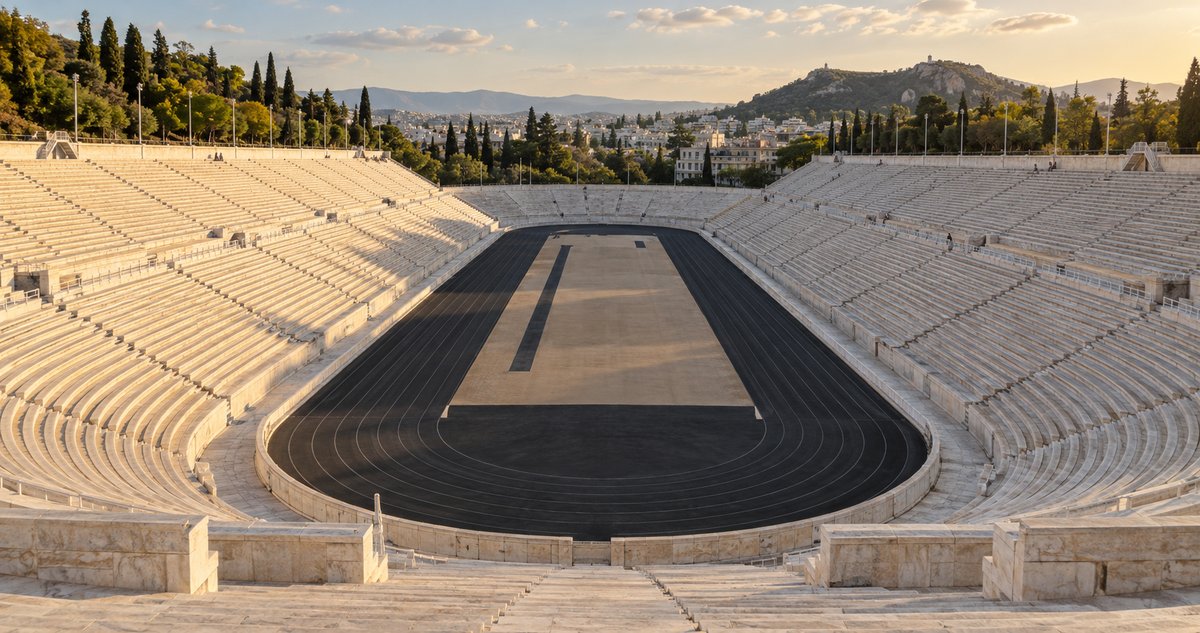
The Panathenaic Stadium gave the event a striking physical centre. The Canadian Olympic Committee describes fundraising through souvenir stamps and medals, alongside a major donation from businessman Giorgios Averof for the stadium's reconstruction. Behind the symbolic return to Greece lay a less glamorous requirement: obtaining the resources to make it happen.
The stadium connected the new competition with Greece's past, while its preparation depended on present-day money, construction and organization. Its appearance could appear to embody a timeless sporting tradition, yet fundraising and practical decisions were essential to the opening. The symbolic setting and the work needed to produce it are therefore both parts of the event's history.
Recognizable sport, unfamiliar customs
The Australian and Canadian Olympic committees record 241 male competitors from 14 nations and 43 events across nine sports. The programme included athletics, swimming, fencing and cycling. These figures describe an international gathering on a much smaller scale than the word Olympics may suggest to a reader familiar with later Games.
First-place finishers received silver medals, an olive branch and a diploma, rather than the gold medals familiar today. James Connolly won the triple jump on the opening day, and Spyridon Louis's marathon victory became a celebrated moment for the host country. Winners received recognition, but its material symbols had not yet taken their later form.
A modern medal table can summarise the results conveniently. To understand the 1896 event itself, however, we also need to know what its winners actually received. Describing them through today's customs alone would hide how Olympic traditions developed.
Who belonged to the revival?
All the official competitors in Athens were men. Women first participated in the modern Olympics at Paris in 1900. This exclusion complicates an account centred only on international friendship: expanding a competition across national borders did not mean that everyone could enter it. The event's reach and its restrictions existed together.
Athens 1896 established an influential modern competition, while many familiar conventions and opportunities developed later. Its historical importance includes both that beginning and the changes that followed. Continuity with the past does not require prizes, institutions or eligibility to remain permanent. In this interpretation, understanding tradition means recognising how choices made at one moment can be revised by later generations.
Three questions
Try answering before you open the answer. You can use your own words.
- Why does the article qualify the word revival?
Show answer
The modern Games drew on ancient inspiration but required new institutions, organizers and practical choices.
- Which prize challenges the assumption that Olympic winners have always received gold?
Show answer
First-place finishers in Athens received silver medals, an olive branch and a diploma.
- How does the exclusion of women complicate the idea of international friendship?
Show answer
The competition crossed national borders while still limiting who could participate.
Let's talk about it
A few ideas to chat about - pick any that interest you.
- Which sporting tradition have you seen change during your lifetime?
- What would you like a museum to show about both the achievements and exclusions of these Games?
- Do changes to a tradition make it feel less familiar to you, or help it stay relevant?
- If you were helping organise a new sporting tradition, whose views would you want at the table?
- What makes an international sporting event feel like a shared celebration rather than a competition between nations?
Practise a useful pattern
Use qualification to refine a claim: "Continuity can be real without making every rule permanent." Write a sentence that acknowledges a historical achievement while identifying a limitation.
Frequently asked questions
When did the first modern Olympics begin?
They opened in Athens on 6 April 1896 and ran until 15 April.
Did women compete in Athens 1896?
No. All official competitors were men; women first competed in the modern Olympics at Paris in 1900.
Sources and editorial notes
Original learning article by Poly-Puff, written from the factual sources below. Sources checked on 13 October 2026. The artwork and learning activities were created for this article.
Participation figures follow the Australian and Canadian Olympic committees; the Norwegian Olympic Museum gives a different athlete total. Prize details are described as awarded in 1896, rather than retrospectively applying modern gold-medal terminology. Interpretation of continuity and exclusion is original editorial analysis.