1959: The Antarctic Treaty Makes Space for Cooperation
Twelve countries found a way to cooperate in Antarctica while leaving their disagreements over territory unresolved.
Estimated CEFR reading level: C1. Sustained argument, diplomatic vocabulary and distinctions between rules and interpretation support the C1 estimate. This is an editorial estimate, not an official certification.
Five useful words
British English pronunciation (IPA). Audio uses an available English voice on your device.
sovereignty /ˈsɒvrənti/
nounA state's authority to govern a territory.
The agreement did not settle every question of sovereignty.
compliance /kəmˈplaɪəns/
nounActing in accordance with rules or an agreement.
Observers could check compliance.
provision /prəˈvɪʒən/
nounA particular rule or condition in an agreement.
One provision allowed inspections.
assurance /əˈʃʊərəns/
nounA statement intended to give confidence that something is true.
The inspectors sought evidence beyond an assurance.
constrain /kənˈstreɪn/
verbTo limit an action or behaviour.
Shared rules can constrain harmful conduct.
The story
On 1 December 1959, twelve countries signed the Antarctic Treaty in Washington. Their scientists had worked in and around Antarctica during the International Geophysical Year of 1957-58. The agreement, which entered into force in 1961, sought to preserve the conditions for peaceful research on a continent where national ambitions could otherwise have collided.
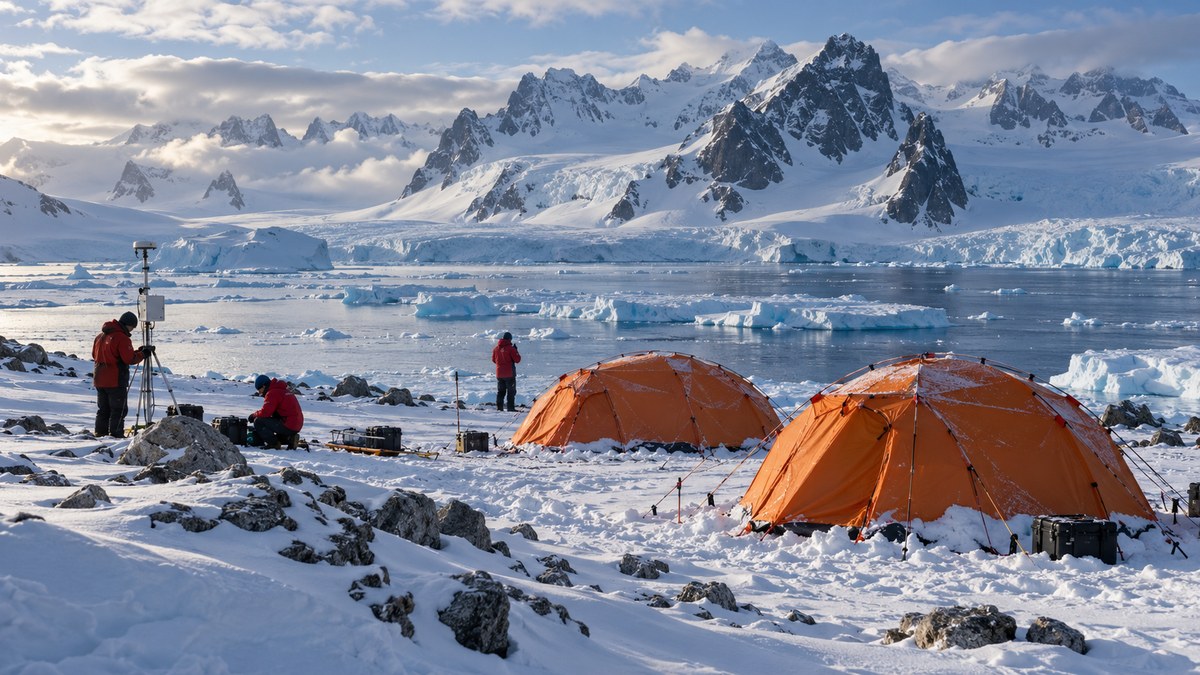
Its approach was practical as well as ambitious. Antarctica would be used for peaceful purposes, while scientific investigation and international cooperation would continue. Exchanging observations could make research useful beyond the country that collected them. Sharing information about planned programmes could also reduce duplicated effort in a place where fieldwork was exceptionally demanding.
The treaty did not require every participant to accept the same answer to the question of ownership. Some countries already claimed territory; others rejected those claims or maintained different positions. Article IV protected those positions while preventing new claims or the enlargement of existing ones. Cooperation could proceed without a final settlement of sovereignty.
That distinction matters. Leaving a dispute unresolved is different from making it disappear. The treaty created rules within which states could work together despite disagreement. In this reading, that arrangement illustrates a wider diplomatic possibility: agreement about conduct may be achievable before agreement about underlying rights.
The peaceful-purpose rule also needs careful reading. Military measures, including weapons testing, were prohibited. Military personnel or equipment could nevertheless support scientific research or another peaceful purpose. A uniform or a supply aircraft would therefore not, by itself, demonstrate a violation. Purpose and activity mattered.
Inspection provisions supplied another part of the arrangement. Designated observers could inspect stations and equipment, allowing participants to check compliance rather than rely entirely on assurances. The right of inspection connected an international promise with a means of examining what happened on the ground.
The original agreement should not be confused with every rule now associated with Antarctica. Later instruments developed additional environmental protections. Nor did the 1959 signing instantly complete the process: entry into force followed in 1961. Its enduring historical lesson is narrower and more interesting than a claim that rivalry ended. Countries established ways to share knowledge, constrain behaviour and continue working while important disagreements remained.
A short timeline
- 1957-58
International Geophysical Year research strengthens scientific cooperation.
- 1 December 1959
Twelve countries sign the treaty in Washington.
- 1961
The treaty enters into force.
Three questions
Try answering before you open the answer. You can use your own words.
- How did the treaty allow cooperation without settling ownership?
Show answer
Article IV preserved existing positions while preventing new or enlarged territorial claims.
- Why would a military supply aircraft not automatically prove a breach?
Show answer
Military personnel and equipment could be used for scientific research or another peaceful purpose.
- What did inspection add to promises of peaceful conduct?
Show answer
It gave designated observers a means to examine compliance rather than depend entirely on assurances.
Let's talk about it
A few ideas to chat about - pick any that interest you.
- What would interest you most about visiting an Antarctic research station?
- Have you worked with someone while disagreeing about another issue?
- Which scientific discovery would you like countries to investigate together?
- What makes a shared set of rules feel fair to you?
- What part of life in Antarctica would you like to learn more about?
Practise a useful pattern
Use while to express two facts that coexist despite tension. Write about cooperation.
Example: The countries shared scientific knowledge while maintaining different territorial positions.
Frequently asked questions
When was the Antarctic Treaty signed and when did it take effect?
Twelve countries signed it on 1 December 1959 in Washington. It entered into force in 1961.
Did the treaty remove all territorial claims?
No. Article IV preserved the parties' positions and prevented new claims or enlargement of existing claims while the treaty remained in force.
Sources and editorial notes
Original learning article by Poly-Puff, written from the factual sources below. Sources checked on 20 October 2026. The artwork and learning activities were created for this article.
This is a historical explanation, not legal advice. The treaty text supports the distinction between military measures and peaceful logistical support. The discussion of cooperation despite disagreement is editorial interpretation. Later environmental agreements are not backdated to 1959.