IELTS Reading: True, False and Not Given Explained
Separate contradiction from missing information in IELTS Reading. Follow a short original passage, three explained comparisons and a practical evidence check.
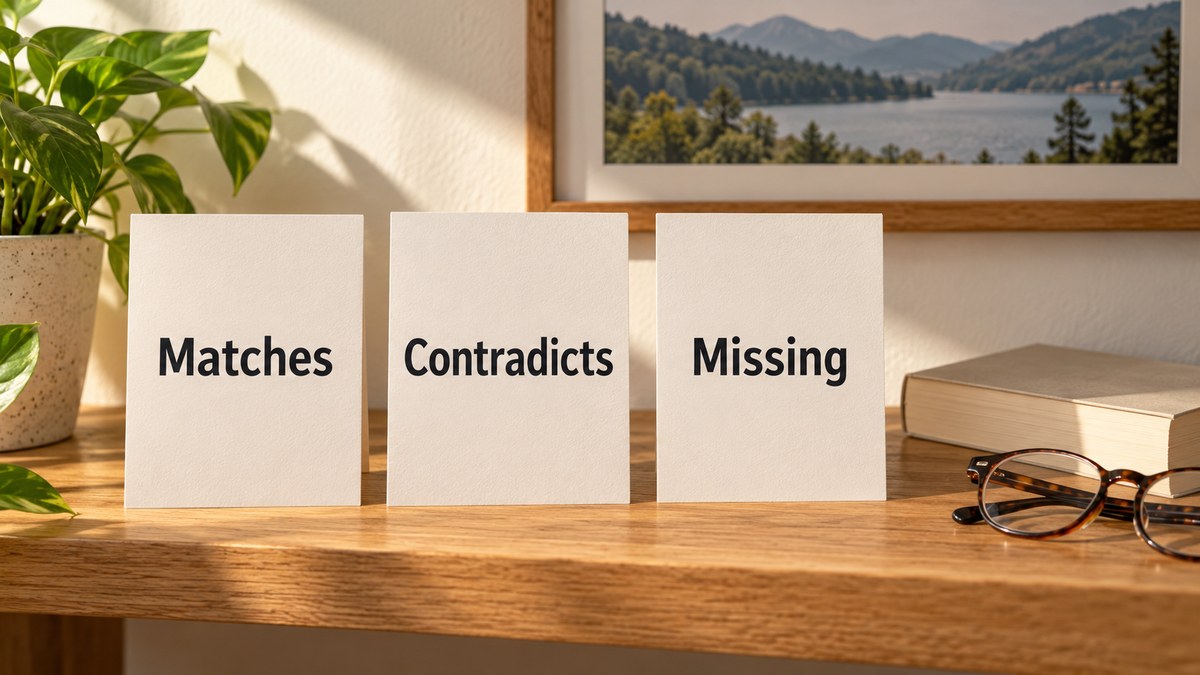
The awkward choice in IELTS Reading is often between False and Not Given. False needs a contradiction: the passage tells you something incompatible with the statement. Not Given means the passage does not establish agreement or disagreement. An unsupported claim is not automatically a false one.
Compare meanings, not matching words
True means that the information supports the statement, even when the wording differs. Locate the relevant part of the passage and read closely enough to understand the whole claim. A shared keyword can identify a useful area, but it cannot tell you the relationship on its own.
See the three relationships together
Original passage: Riverside Library opened in 2008. Its reading room closes at 6 pm on weekdays.
| Statement | Relationship | Explanation |
|---|---|---|
| The library opened before 2010. | True | The stated year, 2008, is earlier than 2010. |
| The reading room closes at 7 pm on weekdays. | False | The passage gives 6 pm for the same room and days. |
| The library opens on Sundays. | Not Given | The passage says nothing about Sunday opening. |
The Sunday statement feels plausible because libraries often publish opening hours. That general knowledge is irrelevant here. The passage gives a weekday closing time for one room, not a full weekly schedule. Nothing in it proves either that the library opens on Sunday or that it stays closed.
Check who, when and how much
Pay attention to the person, group, time and quantity in each statement. A claim about one branch is not necessarily a claim about every branch. Words such as only, usually and all can change the meaning substantially. They deserve attention, but none automatically determines an answer without the surrounding evidence.
Give yourself a reason to choose
A useful study habit is to record the relationship in a few words: supported by this sentence, contradicted by this detail, or this particular fact is missing. If you choose False, identify what conflicts with the statement. If you choose Not Given, identify what information you would need to decide.
Use the labels the task asks for
True/False/Not Given questions concern information in the passage. Yes/No/Not Given questions concern the writer's views or claims. The reasoning is related, but the required labels differ. Read the instruction instead of carrying the previous task's labels into the next one.
Review the decision, not just the result
When reviewing official practice, compare your reasoning with the relevant text before moving on. Separate a vocabulary misunderstanding from an assumption you added yourself. I would keep a short note of the exact habit to change, such as checking a time expression or refusing to turn missing evidence into a contradiction.
More IELTS guidance
For the wider test choices, see Academic versus General Training. Continue with Task 2 essay planning or preparing for Speaking Part 2.
Sources and editorial notes
IELTS: identifying information and identifying the writer's views; British Council: teaching resources on T/F/NG and Y/N/NG distinctions. References checked on 20 October 2026. The library passage, comparisons and explanations are original Poly-Puff examples. Every interpretation is visible beside its statement; this post is explanatory guidance, not a reader quiz or an official test task. No outside facts about real libraries are needed. The review routine is an optional study suggestion.
Put useful English into practice
Explore IELTS Practice and keep useful language in your learning routine.