Gerunds and Infinitives: When to Use -ing and To
Understand common gerund and infinitive patterns, prepositions and the difference between stop doing and stop to do, with useful examples.

Learn the whole pattern: enjoy cycling, but plan to cycle. When a verb follows a preposition, use -ing. Some verbs allow both forms; with stop, the form changes the meaning.
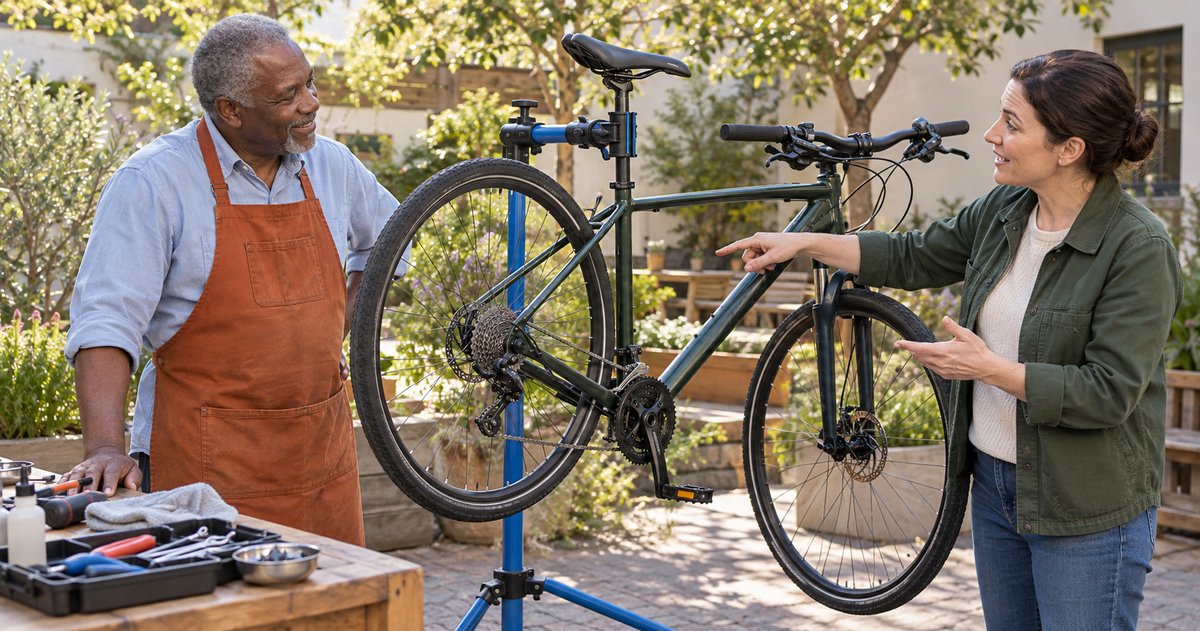
Two friends are planning Saturday. One enjoys cycling; the other wants to take photos. Both sentences describe activities, but the first verb determines the second form. A gerund is an -ing form used like a noun. This guide compares everyday gerund patterns with to plus a base verb.
Use -ing after enjoy, finish and mind
When these verbs introduce another action, use the -ing form. Avoid and consider belong to this group too. Learn a short phrase for each verb instead of guessing from its meaning. Change the first verb for tense; keep the second pattern.
I enjoy cycling along the river.
We finished packing before breakfast.
She doesn't mind waiting outside.
Yesterday, I enjoyed cycling with my brother.
Use to + base verb after want, decide and hope
Plan, promise and offer also commonly take a to-infinitive. Keep the verb after to in its base form, even when the subject is she or he. Put not before the to-infinitive to make that second action negative.
He wants to take photos.
They decided to meet early.
We hope to arrive before lunch.
I decided not to drive.
After a preposition, choose -ing
A verb following a preposition takes the -ing form: after leaving, without asking, interested in learning. In look forward to, to is a preposition, so write meeting. This is different from the to in want to meet, which introduces an infinitive.
Check the weather before leaving.
I'm interested in learning photography.
We look forward to meeting you.
Some verbs accept both
Like and love can take either form when you talk about preferences. Do not change every -ing phrase into an infinitive. Would like follows a different pattern: use would like to go when expressing a wish or making a polite offer.
I like walking / I like to walk in the morning.
I would like to join your walk.
Stop doing and stop to do mean different things
Stop doing means you end the named activity. Stop to do means you pause another activity for a purpose. Imagine a cyclist: stopping cycling ends the ride; stopping to take a photo pauses the ride so the cyclist can use the camera.
We stopped cycling when we reached home.
We stopped to take a photo of the bridge.
Learn useful verb patterns as complete phrases
Store the verb with its following form
I enjoy trying new recipes keeps enjoy with an -ing form. She hopes to visit us keeps hope with to plus the base verb.
Recognise a prepositional pattern
Thank you for helping me uses -ing after for. We look forward to seeing you also uses -ing because to belongs to a prepositional phrase here.
Read the whole meaning
She stopped to rest makes resting the purpose of a pause. She stopped working describes ending an activity. Would you like to join us? uses a to-infinitive after would like.
Related guides
Continue with modal verbs and their patterns and learning useful word combinations.
A small change can change the purpose
The different jobs of -ing forms
In “I enjoy cycling,” cycling names an activity. In “I am cycling,” am cycling is a continuous verb form.
Enjoy with -ing
Use enjoy swimming. Some verbs accept both forms, but enjoy takes -ing when another verb follows it.
Remember a complete pattern
Save a complete example such as “I plan to visit my sister.” Make a second sentence about your own plans, then recall it later without looking.
Further reading
British Council: common verb patterns; to-infinitives; -ing forms and prepositions; verb patterns that change meaning. References checked on 11 October 2026. Explanations, examples and practice on this page are original.
Keep useful verb patterns in practice
Explore Grammar Practice and save your own useful examples in your Word Vault.