ESL Writing Activities for Adults: Short Messages, Useful Revisions
Plan adult ESL writing activities with practical outcomes, useful peer feedback, level adaptations and a complete lesson plan.
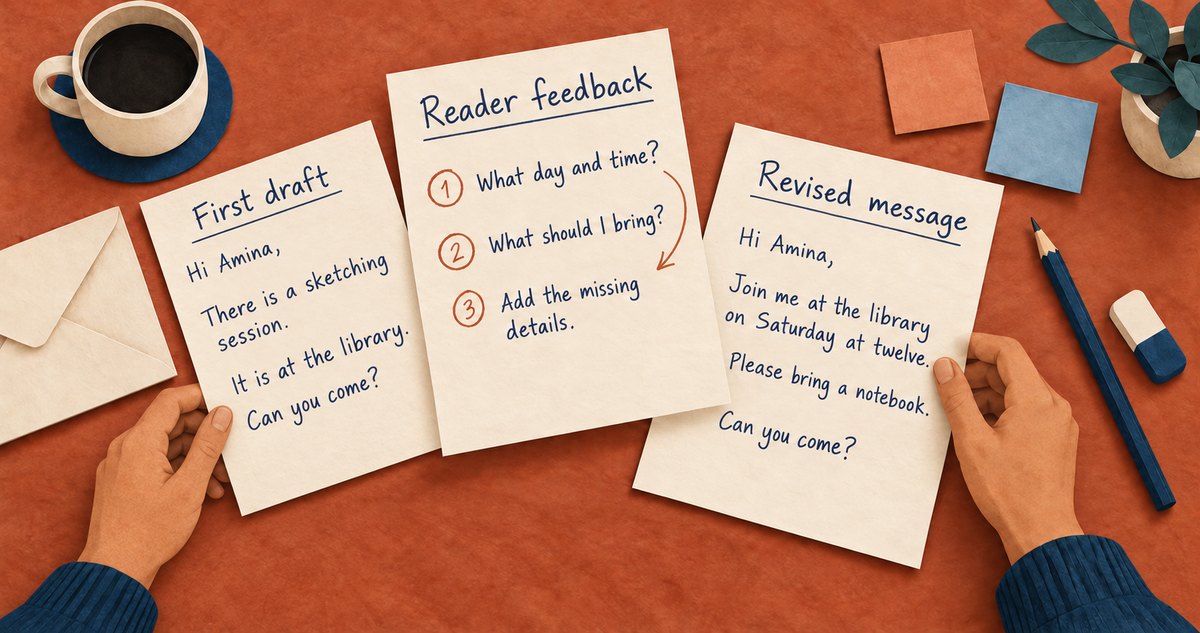
Give learners a reader, a reason to write and a manageable message. Let them plan briefly, produce a draft, hear what a reader understood and revise one thing. A short text that enables a response can reveal more than a long text with no clear purpose.
Start with the reader's next action
Choose a familiar situation such as inviting a friend or explaining a change. Decide what the reader should be able to do after reading. Use fictional names and situations so learners can participate without sharing personal experiences. Keep the purpose visible while you introduce the language.
Separate composing from checking
Show a small model and ask what information makes it useful. Allow notes, oral rehearsal or a word bank before the first draft. During writing, help learners communicate missing ideas. Leave a limited accuracy check for the revision stage rather than interrupting every sentence.
Make feedback something writers can use
Ask the partner to identify the time, place and requested action. A missing detail creates a specific revision target. Invite the writer to make the change, then check whether the reader can respond. Comment on one successful choice as well as one improvement; avoid rewriting the whole message for the learner.
Adjust support without hiding individual work
Offer A2 learners sentence starters and fewer details. Ask B1 learners to connect information clearly; challenge B2 learners to adapt tone or explain a change tactfully. Let everyone keep a first and revised draft. Collect a short independent ending so a helpful partner does not mask what each writer can do.
Keep the lesson focused
The activities below form one original sequence, not a claim about guaranteed progress. If learners need longer to draft, shorten an extension and retain a revision and exit check. Learners developing literacy may need extra work on letter formation or digital input before attempting this sequence.
Prepare one fictional invitation
Outcome: Each learner writes and revises a short invitation containing the place, day/time, item to bring and a clear response question. Print the details and model, or share them in a plain document. The event is invented for classroom use.
Event details
A free sketching session at the community library, Saturday at 12:00. Bring a notebook. Invite a friend and ask whether they can come.
Original model
Hi Amina, there's a free sketching session at the community library on Saturday at twelve. I'm going, and I'd like you to join me. Please bring a notebook. Can you come?
Three original classroom activities
1. Build the reader's checklist - 6 minutes
CEFR: A2-B2. Pairs read the model, mark four essential details and explain what the recipient must do. Hide the model; each learner makes a four-item plan for their own invitation.
Check: Every learner's plan includes place, day/time, notebook and a response question.
2. Draft and read as a recipient - 8 minutes
CEFR: A2-B2. Each learner writes four to six sentences from the event card. Exchange drafts. The recipient writes the event details they understood and circles one unclear or missing point, without rewriting the invitation.
Check: The writer sees whether the reader recovered the intended details, rather than receiving only a grammar score.
3. Revise and get a real response - 8 minutes
CEFR: A2-B2. Writers repair the identified point and check one language target, such as time prepositions. Partners respond with an acceptance or a clarification question. Compare first and revised versions and explain one improvement.
Check: Each learner makes an identifiable revision and receives a response that matches the message.
Level and online adaptations
A2: offer On Saturday at ___ and Can you ___? frames and a place/bring word bank. B1: remove frames and request a short reason to attend. B2: change the recipient to a new colleague and discuss suitable tone. Online: give each learner their own document area, then exchange reader comments; do not let a partner silently edit the writer's draft.
A complete 30-minute lesson plan
- 0-4 minutes: Introduce the audience and goal; demonstrate an invitation and a reader response.
- 4-10 minutes: Activity 1: build the checklist and plan individually.
- 10-18 minutes: Activity 2: draft independently and exchange reader feedback.
- 18-26 minutes: Activity 3: revise, respond and discuss one improvement.
- 26-30 minutes: Exit check: independently write two sentences giving a changed time and asking for a reply. Use Sunday at 14:00; collect each learner's version.
Feedback and an individual check
Record whether each learner included essential information, made a useful revision and independently expressed the changed time. Give one content comment and one chosen accuracy comment. Use the exit messages to plan follow-up practice; the timings are adjustable classroom suggestions.
Feedback that gives a writer a useful next step
Respond to the missing information
An invitation should give the event details and request a response. A reader asking what time it starts gives the writer a specific detail to add.
Keep the writer responsible for the revision
Readers can report what they understood and ask for clarification. The original writer then revises; sentence starters and a word bank should support that choice rather than make it for them.
Look at the change as well as the draft
A first draft, revision and explanation of one reader-focused change show the process. A new individual message at the end helps you distinguish learning from a partner's contribution.
Related guides
Professional email in English; Planning an adult ESL lesson; Teaching mixed-level classes.
Keep revision connected to the reader
Length follows the writing purpose
Start with the purpose and learner readiness. This sequence uses four to six sentences, then a two-sentence exit check; those lengths are suggestions, not universal limits.
Feedback for a first draft
For these tasks, respond to meaning first and select a limited accuracy focus during revision. Adapt feedback to the learner and the lesson goal.
Revision in an online lesson
Use individual document areas and exchanged reader comments, while retaining each learner's first draft, revision and independent exit message.
Further reading
British Council TeachingEnglish: process writing; Center for Applied Linguistics: teaching writing to adult English learners. References checked on 12 October 2026. Both references were opened. They inform the general planning, audience and revision approach. The invitation, activities, feedback checks, timings and adaptations are original editorial suggestions, not copied worksheets or measured intervention results.
Keep useful English in practice
Explore Writing and save useful examples in your Word Vault for review.