Space Dust Holds Clues to Planetary Collisions
Webb studies warm dust around stars to investigate how rocky worlds may collide.
Estimated CEFR reading level: B2. An explanation of scientific evidence and inference, with technical vocabulary and cautious conclusions. This is an editorial estimate, not an official certification.
Five useful words
British English pronunciation (IPA). Audio uses an available English voice on your device.
debris /ˈdebriː/
nounBroken pieces left after damage or a collision.
The storm left debris on the road.
collision /kəˈlɪʒən/
nounAn event in which two moving objects hit each other.
The collision damaged both bicycles.
infrared /ˌɪnfrəˈred/
adjectiveDescribing light beyond the red end of the visible spectrum.
An infrared camera can detect heat that our eyes cannot see.
composition /ˌkɒmpəˈzɪʃən/
nounThe materials or parts that make something up.
The composition of the soil affects which plants can grow.
infer /ɪnˈfɜː/
verbTo reach an explanation by considering evidence.
From the wet pavement, we inferred that it had rained.
The story
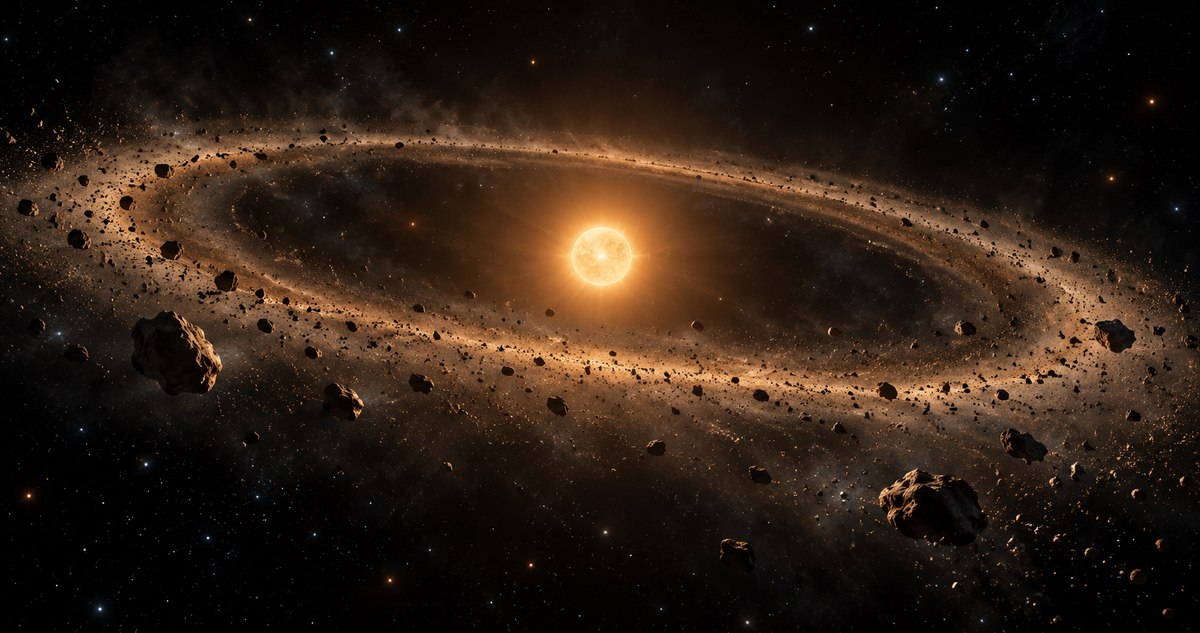
On 1 October 2026, NASA described Webb research into warm dust around distant stars. Astronomers used infrared light to study the debris. A spectrum separates light into wavelengths, helping identify its composition.
The team found silica-rich and silica-poor dust. They linked silica-rich material with energetic impacts between larger rocky bodies, and silica-poor material with less energetic collisions involving smaller bodies. These are inferences from fragments, not recordings of planets colliding.
The research provides comparisons with our own Solar System. A leading explanation for the Moon is that material from a major impact involving young Earth came together to form it. Other systems cannot replay that particular event, but they offer clues about similar processes.
A broken cup offers a familiar comparison. Its pieces show that it broke, but explaining how it broke requires more evidence. In the same way, distant dust gives astronomers clues about collisions. Further observations help them test their explanations without assuming that the fragments reveal every detail of an impact.
From light to an explanation
- Collect lightA telescope records infrared light from a dusty system.
- Identify materialsSpectral features help researchers study the dust.
- Test an explanationScientists compare the evidence with ideas about collisions.
An original simplified process diagram. The observations provide clues; they do not film an impact.
Three questions
Try answering before you open the answer. You can use your own words.
- What did Webb help researchers investigate?
Show answer
The materials in warm dust around stars.
- Did the telescope record two planets colliding?
Show answer
No. Researchers inferred possible collisions from the debris.
- Why does the reading mention the Moon?
Show answer
Its possible impact origin provides a comparison with the processes studied around other stars.
Let's talk about it
A few ideas to chat about - pick any that interest you.
- What might you be able to learn from the pieces of a broken object?
- When you hear that evidence 'suggests' something, how certain does it sound to you?
- Would you rather investigate a distant planet or a familiar place on Earth?
- Would you enjoy seeing how scientists turn a measurement into a possible story about a collision?
- What would make you want to follow up on a discovery about dust rather than a photograph of a planet?
Separating evidence from inference
Use "The observations show..." to describe evidence and "This suggests..." to introduce an interpretation. Complete two sentences about the broken cup example, one for each purpose.
Sources and context
An original learning article by Poly-Puff, written from the factual sources below. Sources checked on 5 October 2026. The artwork and learning activities were created for this article.