Could a Hole on the Moon Lead to a Future Shelter?
NASA has selected an investigation of the Marius Hills Pit. The question is what lies beyond the opening.
Estimated CEFR reading level: B2. Conditional statements distinguish a possible shelter from a confirmed result, with technical vocabulary explained through concrete examples. This is an editorial estimate, not an official certification.
Five useful words
British English pronunciation (IPA). Audio uses an available English voice on your device.
investigation /ɪnˌvestɪˈɡeɪʃən/
nounAn organised attempt to find out facts.
The investigation will study the lunar pit.
lava tube /ˈlɑːvə tjuːb/
nounA passage left when flowing lava drains away beneath a hardened surface.
Scientists want to know whether a lava tube lies below.
radiation /ˌreɪdiˈeɪʃən/
nounEnergy travelling as waves or particles.
Underground rock could help shield astronauts from radiation.
habitat /ˈhæbɪtæt/
nounA place designed or used for living.
A future lunar habitat would need protection.
confirm /kənˈfɜːm/
verbTo establish that something is true.
Measurements could confirm whether a passage exists.
The story
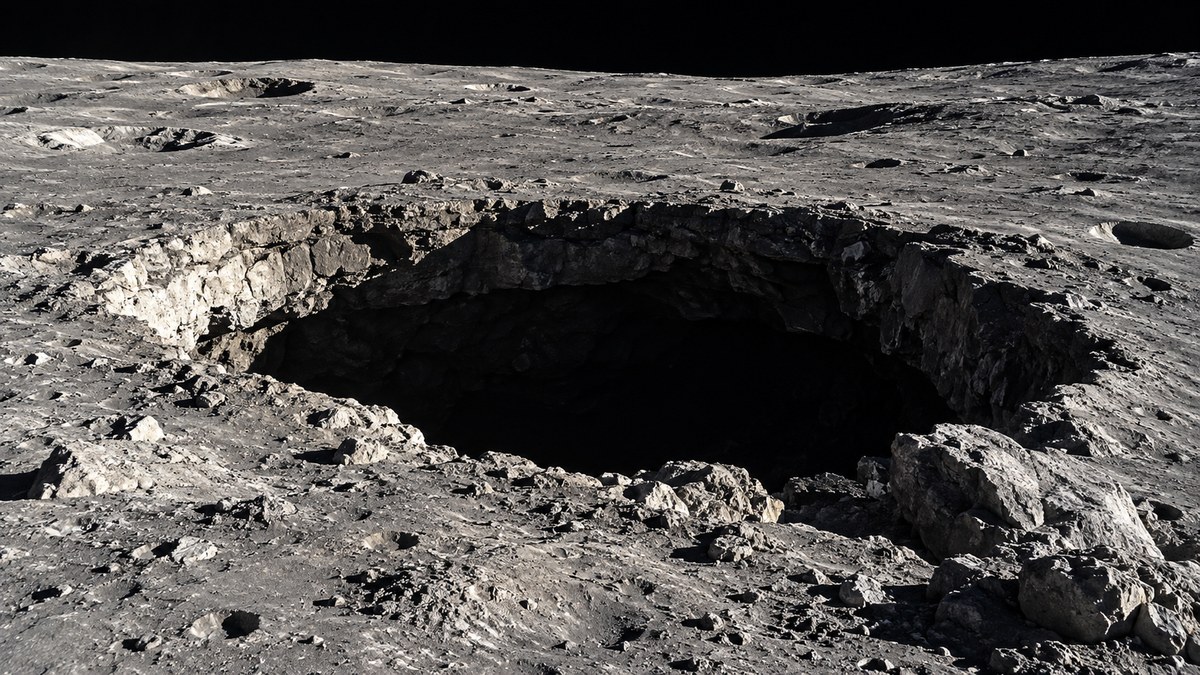
A hole in the Moon's surface could be more than an interesting landmark. NASA has selected an investigation to find out whether the Marius Hills Pit connects to a large underground lava tube. Such a space might one day help protect astronauts.
The investigation, called GIMLI, was announced on 30 September 2026 in a release updated on 2 October. Its instruments are intended to scan below the surface. The aim is to learn whether ancient volcanic activity left an underground passage, rather than assuming that a useful cave is already confirmed.
Why look below ground? NASA says natural rock could offer protection from harmful radiation, tiny incoming space particles and extreme temperatures. That possibility makes the question relevant to future habitats.
GIMLI is one of three newly selected investigations. The others will study environmental hazards and hidden ice. Selection is an early step: it is not a report of instruments already operating at the pit. Nor does a possible lava tube automatically become a safe home. Measurements must come before decisions about where people could live.
Three questions
Try answering before you open the answer. You can use your own words.
- What does GIMLI aim to find out?
Show answer
Whether the Marius Hills Pit connects to a large underground lava tube.
- How could natural rock help astronauts?
Show answer
It could provide protection from radiation, incoming particles and extreme temperatures.
- Are GIMLI's instruments already reported to be operating at the pit?
Show answer
No. The source announces selection of the investigation, not completed deployment or results.
Let's talk about it
A few ideas to chat about - pick any that interest you.
- Would you prefer a Moon habitat underground or one with a view of the surface?
- What would you most want to know before visiting a lunar cave?
- Does a natural shelter or a purpose-built building appeal to you more?
- Which part of planning a Moon settlement seems most interesting?
- How do you feel about discoveries that begin with a question rather than a clear answer?
Practise a useful pattern
Use if and could to describe a possibility without presenting it as a result. Write a sentence about the possible underground passage.
Example: If the pit connects to a lava tube, the rock could provide useful protection.
Frequently asked questions
Has NASA confirmed a safe home inside the Marius Hills Pit?
No. The selected investigation aims to determine whether the pit connects to a lava tube; suitability as a habitat has not been established.
When was GIMLI announced?
NASA announced the selection on 30 September 2026 and updated the release on 2 October to correct payload names.
Sources and editorial notes
Original learning article by Poly-Puff, written from the factual sources below. Sources checked on 17 October 2026. The artwork and learning activities were created for this article.
The NASA release was read directly, including its corrected GIMLI name. This is a recent mission-selection story, not an announcement that a cave was discovered today. No launch date, completed deployment, confirmed underground dimensions or demonstrated human safety is claimed. The pit image is illustrative.