1215: Magna Carta and the Limits of Royal Power
Magna Carta emerged from a struggle between a king and rebellious barons. Its lasting influence depends on both the original charter and later interpretations.
Estimated CEFR reading level: C1. Qualified historical argument with concession, abstract vocabulary and a distinction between original purpose and later significance. This is an editorial estimate, not an official certification.
Five useful words
British English pronunciation (IPA). Audio uses an available English voice on your device.
charter /ˈtʃɑːtə/
nounA formal document granting rights or setting out rules.
The charter set limits on royal action.
restraint /rɪˈstreɪnt/
nounA limit on power or behaviour.
The barons demanded restraint on royal authority.
arbitrary /ˈɑːbɪtrəri/
adjectiveBased on unchecked choice rather than a consistent rule.
The clause challenged arbitrary imprisonment.
provision /prəˈvɪʒən/
nounA particular requirement or rule in a formal document.
Later lawyers interpreted the provision broadly.
reinterpretation /ˌriːɪnˌtɜːprɪˈteɪʃən/
nounGiving something a different or revised meaning.
Reinterpretation extended the charter's influence.
The story
A settlement under pressure
In June 1215, King John faced a rebellion by powerful English barons. Military setbacks and demands for money had damaged their relationship with the crown. At Runnymede, near the River Thames, the king agreed to a charter intended to settle the conflict. The agreement is traditionally dated 15 June. Its name, Magna Carta, means Great Charter.
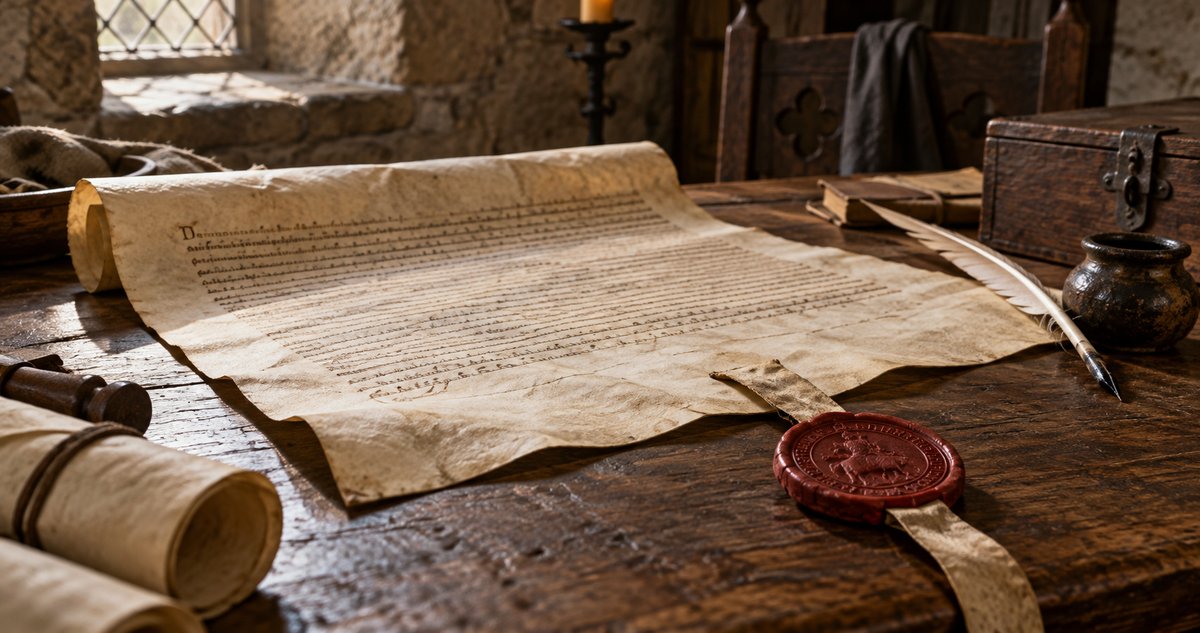
John authenticated the document with his royal seal, rather than signing it in the modern sense. The charter also placed restraints on royal authority, challenging the idea that a king could act without limits. Its provisions addressed taxation, feudal obligations and the treatment of free men, within the relationships and unequal legal status of medieval society.
Rights with boundaries
Some clauses became especially influential because they concerned justice. The charter opposed arbitrary imprisonment of free men and promised that justice would not be sold, refused or delayed. These ideas offered a basis for later arguments that rulers must operate within the law.
The charter did not protect everyone equally. The barons were defending privileges within a deeply unequal society, where many inhabitants were unfree. Magna Carta established neither universal voting rights nor equal protection for all. Those exclusions are essential to understanding the 1215 agreement, even though later generations used its guarantees to support broader claims about government.
Failure and reinterpretation
The initial settlement soon collapsed. John secured the Pope's rejection of the charter, and civil war followed. After John's death in 1216, advisers to his young successor, Henry III, confirmed and reissued it. Revised versions helped the document survive beyond the immediate dispute that had produced it.
Its later influence therefore cannot be explained by the events of one day alone. Lawyers and political thinkers returned to its language, interpreting particular guarantees more broadly and using them to question abuses of authority. Ideas associated with Magna Carta eventually informed constitutional arguments beyond England, including in America.
Magna Carta became influential partly through later reinterpretation. A charter intended to settle an elite conflict supplied language for wider arguments that rulers should obey the law. To understand that development, we need to consider both the original exclusions and the later claims. What the authors sought, whom they protected and how the text was subsequently used are related questions, but they have different answers.
Three questions
Try answering before you open the answer. You can use your own words.
- What immediate problem was the charter intended to resolve?
Show answer
A conflict between King John and rebellious barons.
- Why is it misleading to call the 1215 charter a complete democratic constitution?
Show answer
It protected particular groups within an unequal society and did not establish universal voting rights or equal protection.
- How did the charter remain influential after the original settlement failed?
Show answer
It was confirmed and reissued, and later thinkers reinterpreted its guarantees to support broader arguments about lawful government.
Let's talk about it
A few ideas to chat about - pick any that interest you.
- How do you feel about valuing an old document whose protections excluded many people?
- Can you think of an old text that people understand differently today?
- What would help you appreciate a historical achievement while also understanding its limitations?
- What would you like to ask someone who helped write an agreement that later became famous for different reasons?
- Would displaying several versions of an old document make its history more interesting to you?
Practise a useful pattern
Use a concession to qualify a claim: "Although the charter limited royal power, its protections were unequal." Write a short paragraph using although, yet and therefore to explain the difference between the charter's original purpose and its later influence.
Frequently asked questions
Did King John sign Magna Carta?
He authenticated the charter with his royal seal. A modern handwritten signing scene would be misleading.
Did Magna Carta immediately give everyone equal rights?
No. Its original protections reflected medieval social status. Broader constitutional meanings developed through later interpretation.
Sources and editorial notes
Original learning article by Poly-Puff, written from the factual sources below. Sources checked on 11 October 2026. The artwork and learning activities were created for this article.
The date refers to the traditional date of the 1215 agreement. Later reissues and interpretations are separated from that original settlement. This is historical context, not advice about current legal rights.