1940: Four Young Explorers Find the Paintings of Lascaux
A cave discovery in France opened a window onto prehistoric art and raised a lasting question about protection.
Estimated CEFR reading level: B1. Connected paragraphs, clear event sequencing and a few explained specialist terms support the B1 estimate. This is an editorial estimate, not an official certification.
Five useful words
British English pronunciation (IPA). Audio uses an available English voice on your device.
explore /ɪkˈsplɔː/
verbTo look around a place to learn about it.
The friends wanted to explore the opening.
reveal /rɪˈviːl/
verbTo make something visible or known.
The light revealed a shape on the wall.
prehistoric /ˌpriːhɪˈstɒrɪk/
adjectiveFrom the time before written historical records.
The museum studies prehistoric art.
fragile /ˈfrædʒaɪl/
adjectiveEasily damaged.
The old surface is fragile.
replica /ˈreplɪkə/
nounA copy made to look like an original.
Visitors can learn from a carefully made replica.
The story
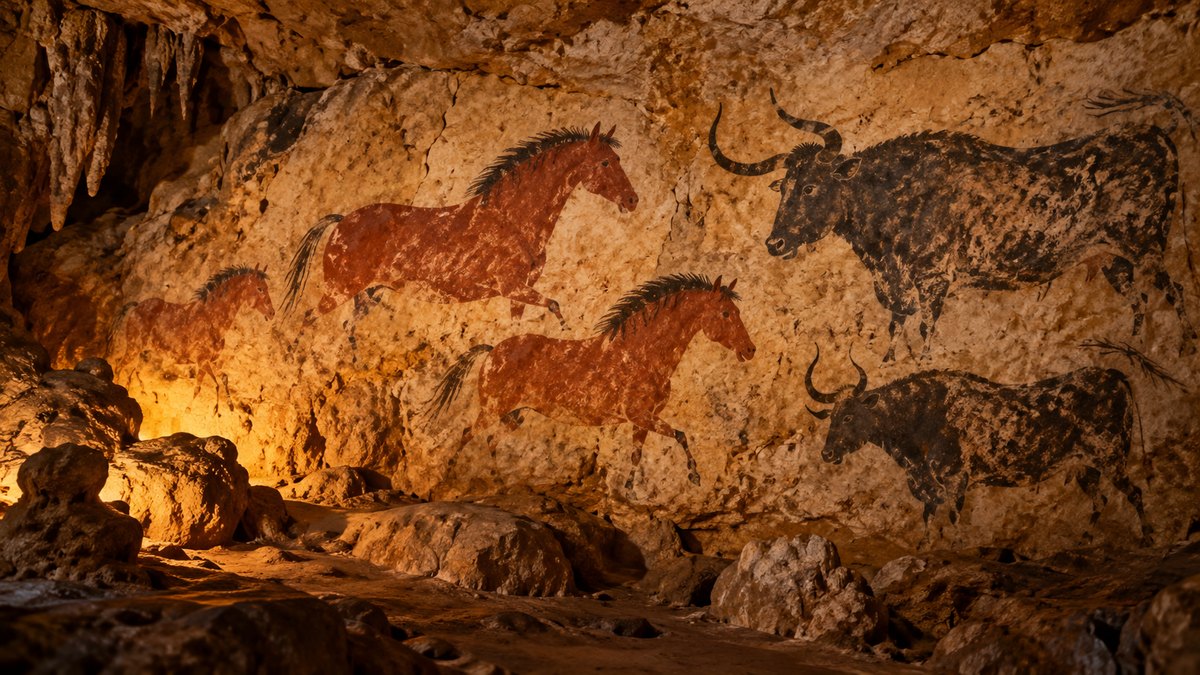
On 12 September 1940, Marcel Ravidat and three friends explored an opening near Montignac in southwestern France. Inside the cave of Lascaux, their lamp revealed animal paintings on the walls.
The pictures were not new. They came from prehistoric people who had lived thousands of years earlier. The discovery brought this hidden art to wider attention. The young explorers told a local teacher, and specialists soon visited.
Lascaux became famous, but sharing the cave created a difficult problem. Large numbers of visitors changed conditions inside its fragile spaces. The original cave closed to the public in 1963 to protect it.
Replicas later offered another way to experience the paintings. The story connects discovery with responsibility: finding something remarkable does not mean everyone can enter it without causing harm. Sometimes protecting a place means changing how people are able to see it.
A short timeline
- 12 September 1940
Four young explorers enter the cave and see its paintings.
- 1963
The original cave closes to the public for protection.
- 1983
Lascaux II opens as a replica of part of the cave.
Three questions
Try answering before you open the answer. You can use your own words.
- Who explored the opening in September 1940?
Show answer
Marcel Ravidat and three friends.
- Were the paintings created in 1940?
Show answer
No. They were made by prehistoric people thousands of years earlier.
- Why did the original cave close to the public?
Show answer
Visitor pressure threatened its fragile conditions and the protection of its art.
Let's talk about it
A few ideas to chat about - pick any that interest you.
- Have you ever found something unexpected while exploring?
- Would you enjoy visiting a cave-art replica?
- What old place near you deserves careful protection?
- How do you feel about limited visitor numbers at a famous site?
- Which animal would you most like to draw?
Practise a useful pattern
Use to plus a verb to explain the purpose of an action. Write a sentence about protecting a place or object.
Example: The museum limits light to protect the colours.
Frequently asked questions
When was Lascaux discovered by the four young explorers?
They entered the cave on 12 September 1940.
Why use replicas of Lascaux?
They allow people to experience the art while helping protect the fragile original cave from ordinary visitor access.
Sources and editorial notes
Original learning article by Poly-Puff, written from the factual sources below. Sources checked on 21 October 2026. The artwork and learning activities were created for this article.
Discovery in 1940 is distinct from the much earlier creation of the paintings. The lesson does not assign a single exact age to all the art or repeat the disputed dog-discovery story. French source material was independently explained in English.