One Field, Two Uses: Crops and Solar Power
Research in Kenya and Tanzania explores how crops and electricity production can share land.
Estimated CEFR reading level: B2. An explanation of research mechanisms, limitations and trade-offs, with technical terms and conditional relationships. This is an editorial estimate, not an official certification.
Five useful words
British English pronunciation (IPA). Audio uses an available English voice on your device.
crop /krɒp/
nounA plant grown by people for food or another useful product.
Beans are an important crop on this farm.
yield /jiːld/
nounThe amount of a crop produced.
The farmer measured this season's yield.
irrigation /ˌɪrɪˈɡeɪʃən/
nounSupplying water to land so plants can grow.
Irrigation keeps the plants watered during dry weather.
evaporation /ɪˌvæpəˈreɪʃən/
nounThe process in which liquid water becomes water vapour.
Evaporation makes the puddle smaller on a hot day.
trade-off /ˈtreɪdɒf/
nounA situation in which gaining one benefit can mean losing another.
There is a trade-off between a low price and a longer journey.
The story
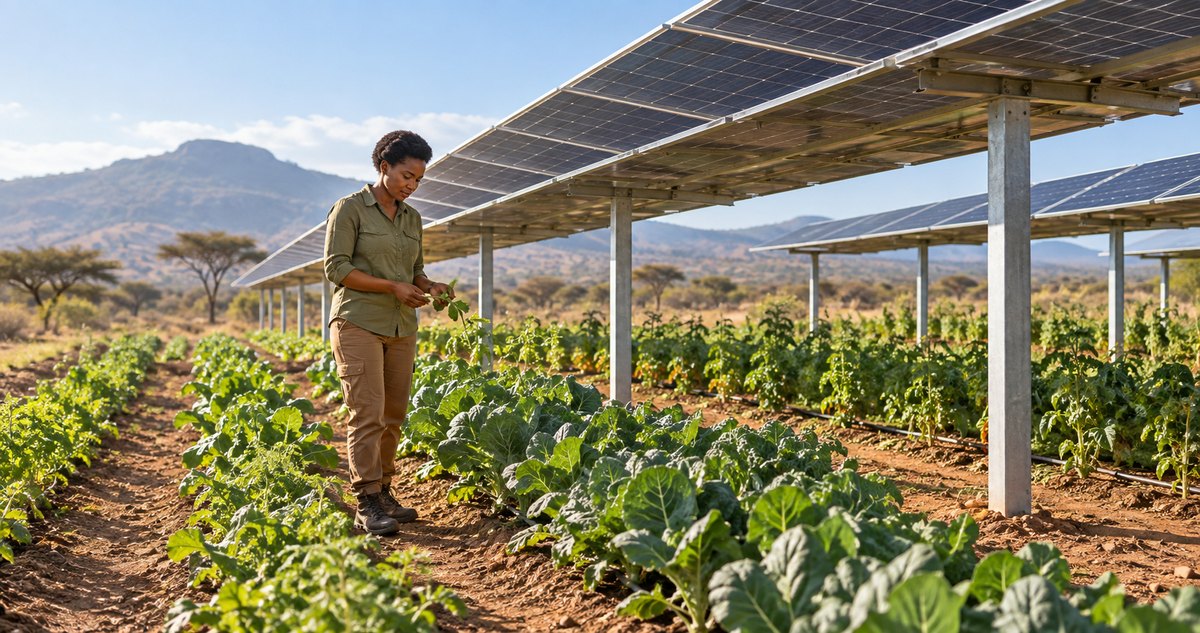
Agrivoltaics combines farming and solar electricity on the same land. Panels stand above crops, which can keep growing underneath them.
On 13 November 2024, the University of Sheffield reported research in Kenya and Tanzania. The paper appeared online in October 2024 and in a 2025 journal volume. At the study sites, some crops performed better with partial shade. Less water escaped through evaporation, reducing irrigation demand. Rainwater from the panels could also be collected.
However, different crops need different amounts of light. Local climate matters too. Results at two sites do not guarantee the same outcome everywhere. A design must balance electricity production with plant needs: there may be a trade-off between them.
Separate East African research identified initial investment costs and uncertainty about land rights as practical barriers. Better crop yields do not by themselves show that a farmer can afford or use the system. A suitable design must therefore account for local resources and rights, as well as the possible food and electricity benefits.
Three parts of the same system
- Panels aboveSolar panels produce electricity and provide partial shade.
- Crops belowPlant performance depends on light, water and local conditions.
- People and planningCosts, land rights and suitable support affect adoption.
An original concept diagram. It is not a construction plan, a yield forecast or evidence that all crops benefit.
Three questions
Try answering before you open the answer. You can use your own words.
- What does agrivoltaics combine on the same land?
Show answer
Agriculture and solar electricity production.
- How could partial shade reduce the need for irrigation?
Show answer
By reducing water loss through evaporation, so some crops need less added water.
- Why can't we assume that the same design will work on every farm?
Show answer
Crop light needs, local climate, costs and land-rights conditions differ. The study-site results do not guarantee universal outcomes.
Let's talk about it
A few ideas to chat about - pick any that interest you.
- Would farming beneath solar panels seem useful in your area?
- What would you want to know before trying partial shade for a crop?
- If you were using a new farming technology, what would you want researchers to ask you?
- How would you feel about seeing solar panels in a landscape used for farming?
- Would you prefer to visit a demonstration farm or hear from farmers who had already tried the idea?
Explaining conditions
Use if and may to keep a claim conditional: "If the crop tolerates partial shade, it may benefit from the panels." Write another conditional sentence about using a new technology in a particular place.
Sources and context
An original learning article by Poly-Puff, written from the factual sources below. Sources checked on 4 October 2026. The artwork and learning activities were created for this article.