1944: Bretton Woods and the Price of Monetary Order
Wartime negotiators designed a monetary framework whose compromises reveal the tension between cooperation and national freedom.
Estimated CEFR reading level: C2. A sustained historical argument involving institutional design, asymmetric power, abstract economic concepts and evaluation of competing definitions of success. This is an editorial estimate, not an official certification.
Five useful words and expressions
British English pronunciation (IPA). Audio uses an available English voice on your device.
institutionalise /ˌɪnstɪˈtjuːʃənəlaɪz/
verbTo establish a practice or principle as part of a durable formal system.
The agreement institutionalised a particular approach to cooperation.
discretion /dɪˈskreʃən/
nounFreedom to decide how to act within a particular situation.
A fixed exchange-rate commitment limits some national discretion.
asymmetry /eɪˈsɪmətri/
nounA lack of equivalence between roles, positions or obligations.
An anchor currency can create an asymmetry between its issuer and other participants.
convertibility /kənˌvɜːtəˈbɪləti/
nounThe ability to exchange one form of money or asset for another under specified rules.
Dollar-gold convertibility was suspended in 1971.
legitimacy /lɪˈdʒɪtɪməsi/
nounThe quality of being accepted as justified or entitled to exercise authority.
The survival of a rule does not by itself establish its legitimacy.
The story
A negotiated design
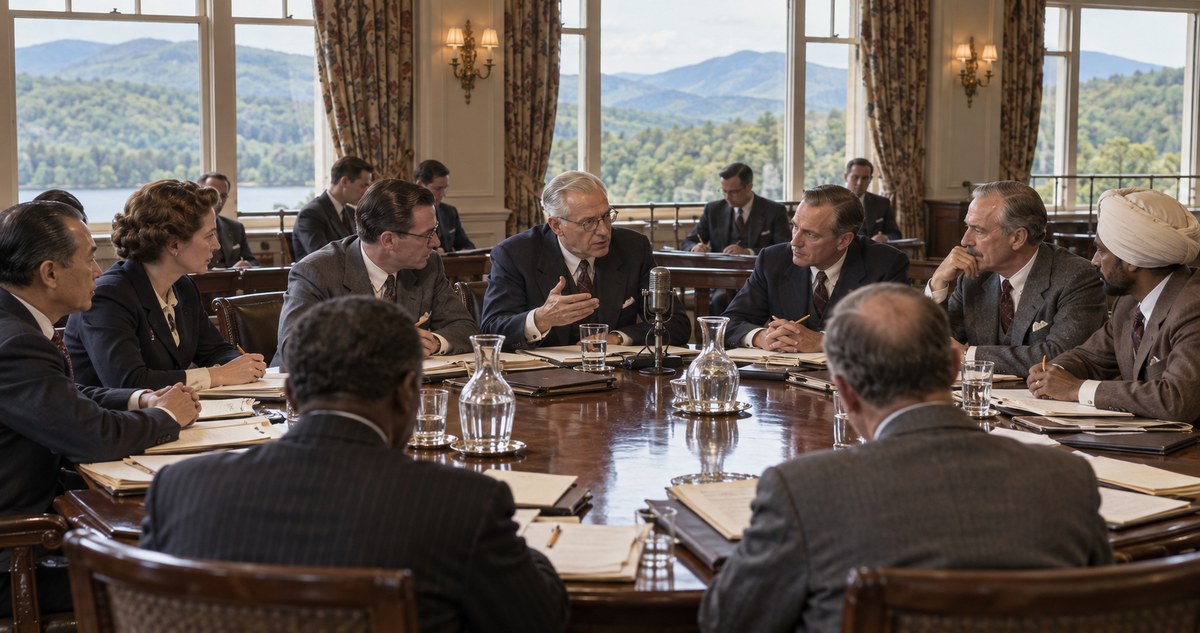
Delegates from forty-four countries met at Bretton Woods, New Hampshire, from 1 to 22 July 1944, while the Second World War continued. They sought arrangements for international economic cooperation. The Final Act contained proposed charters for the International Monetary Fund and the International Bank for Reconstruction and Development. Ratification came later: agreeing a design was distinct from establishing functioning institutions.
Between the wars, competitive currency devaluations and restrictive trade policies had made cooperation difficult. A country could try to help its exporters, only to face similar measures from other countries. Shared rules offered greater predictability but also limited national discretion over policy. Governments still had to decide who would change course when problems arose.
Who would bear adjustment?
John Maynard Keynes proposed a clearing union and an international unit called bancor. His design placed pressure on persistent surplus countries as well as deficit countries. Harry Dexter White favoured a more limited stabilisation fund; the final arrangements were closer to his approach.
Keynes and White therefore differed over who should bear the burden of correcting economic imbalances. A country struggling to meet external payments could be pressed to change domestic policy, while a surplus country might face less pressure. In this article's interpretation, that asymmetry matters because rules allocate obligations. Agreement on stability does not necessarily mean agreement on who should pay for it.
An anchor with obligations
The framework linked currencies to the US dollar through agreed exchange rates, while the dollar was linked to gold. Rates could change in specified circumstances, so stability did not require permanently fixed values. The two institutions also had distinct roles: the IMF supported monetary cooperation and addressed payments difficulties; the IBRD financed reconstruction and development.
A common anchor could simplify coordination while creating dependence on its issuer. US domestic priorities consequently had international implications. Growing foreign dollar holdings placed pressure on gold convertibility. In August 1971, President Richard Nixon suspended dollar conversion into gold; major currencies moved towards floating exchange rates in 1973.
Which outcome counts as success?
The monetary mechanism did not survive intact, but the IMF and World Bank continued. Institutional survival and an unchanged operating rule are distinct outcomes. The events of 1971 therefore cannot alone determine whether the entire project succeeded or failed.
Assessing success depends on what the arrangement was expected to achieve. Creating permanent monetary rules is a different goal from providing useful channels for cooperation under the conditions of the time. Those criteria can produce different judgements. The institutions' endurance does not by itself establish their effectiveness or legitimacy; continued operation can coexist with a need for reform.
In this historical interpretation, shared rules gave economic conflict a structure rather than removing it. Understanding Bretton Woods therefore requires examining its commitments, how it distributed adjustment and which definition of success is being used. Describing only the monetary system's collapse or the institutions' survival leaves those questions unanswered, even though both outcomes are important parts of the story.
Agreement, institutions and changing rules
- 1-22 July 1944Conference delegates develop charters for the IMF and IBRD.
- 27 December 1945IBRD Articles of Agreement are ratified; the conference did not instantly create an operating bank.
- August 1971The United States suspends dollar-gold convertibility.
- 1973Major currencies move towards floating rates; the institutions continue.
Original selected-event timeline, not to scale. Institutional survival and the original exchange-rate mechanism are different outcomes.
Three questions
Explain your answer using evidence from the reading before opening the suggested answer.
- How did Keynes's approach make adjustment a different problem from White's approach?
Show answer
Keynes proposed a clearing union and bancor, with pressure on persistent surplus countries as well as deficit countries. White favoured a more limited fund; the final system was closer to that approach. The argument concerns how the burden of correcting imbalances is distributed.
- Why could an anchor currency provide both coordination and a source of vulnerability?
Show answer
A common reference can make payments and exchange relationships more predictable. Dependence on its issuer also makes the system sensitive to tensions between that country's domestic priorities and international commitments.
- Why is 1971 insufficient on its own to settle whether Bretton Woods succeeded?
Show answer
It marks the suspension of dollar-gold convertibility, but the institutions endured and floating developed later. A judgement depends on whether success means permanent operating rules, workable cooperation or another clearly stated standard.
Let's talk about it
A few ideas to chat about - pick any that interest you.
- How would you feel about economic rules that ask both surplus and deficit countries to adjust?
- What would make you trust an international economic institution?
- Can you think of a temporary agreement that you would still consider a success?
- What might encourage a powerful country to accept economic rules that sometimes work against its immediate interests?
- When an international agreement needs updating, how much of its original design would you want to preserve?
Making an evaluative standard visible
Use judged against to specify a standard, to the extent that to qualify scope, and notwithstanding to acknowledge contrary evidence. Write two contrasting evaluations of Bretton Woods, one about the exchange-rate mechanism and one about institutional cooperation. State the standard used in each.
Sources and context
An original learning article by Poly-Puff, written from the factual sources below. Sources checked on 6 October 2026. The artwork and learning activities were created for this article.
It separates the 1944 agreement from later ratification and implementation, and the exchange-rate system from the institutions. The analogies and discussion of evaluation standards are Poly-Puff's editorial interpretation; they are not quotations or a comprehensive judgement of later IMF or World Bank policy.
- World Bank Archives: conference dates, Final Act and later ratification
- Federal Reserve History: proposals, agreed framework and institutional roles
- Federal Reserve History: implementation, subsequent pressures and the 1973 transition
- Federal Reserve History: Nixon's August 1971 suspension of convertibility