IELTS Speaking Part 2: Use Your Minute and Keep Talking
Prepare for IELTS Speaking Part 2 with a one-minute note method, practical ways to develop details and a focused recording routine.
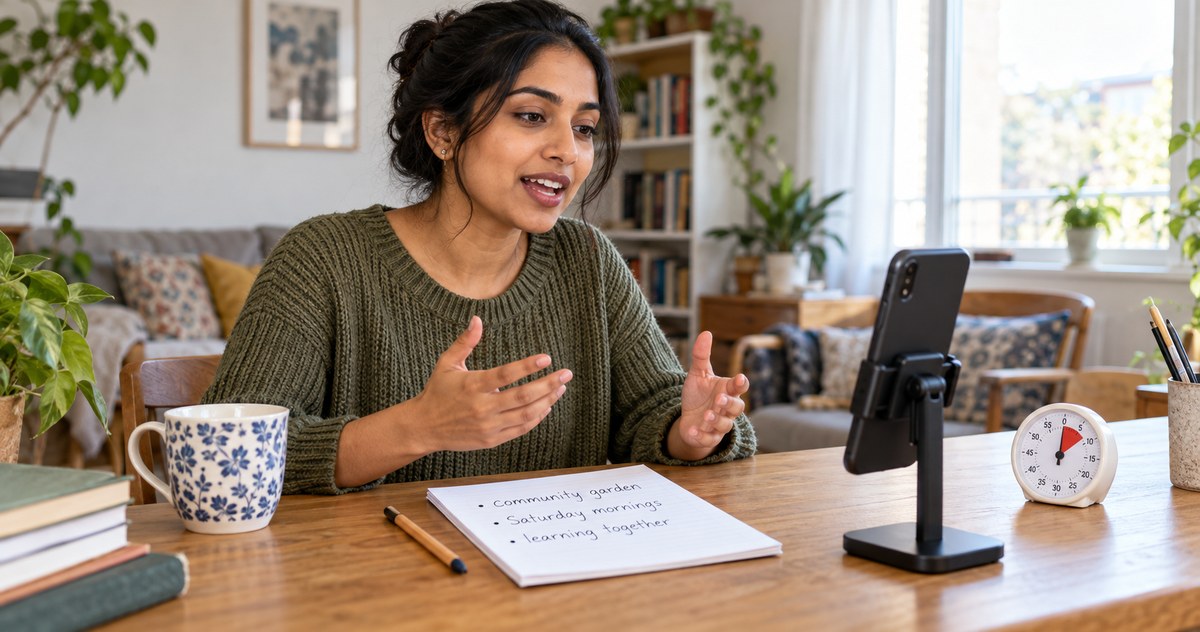
Use your preparation minute to choose a familiar example and jot down prompts that help you develop it. Then speak in a clear order, adding specific details and reasons. The Speaking test is the same for Academic and General Training candidates. This guide offers a practice routine, not a promised score or an official sample answer.
Know the timing and purpose
You receive a task card and have one minute to prepare, with pencil and paper for notes. The long turn gives you one to two minutes to speak; practise sustaining an answer towards two minutes. The examiner stops you when time is up and may ask a brief follow-up. Part 2 takes roughly three to four minutes altogether.
Make notes you can use while speaking
Choose one example early. Write short English phrases beside the points on the card, rather than drafting complete sentences. Leave space for a specific memory and a reason. Put the notes in speaking order so a quick glance helps you continue. This is a flexible classroom method, not an official division of your preparation minute.
Develop one detail at a time
Introduce your example, set the scene and explain what happened. Expand a point with a concrete detail, a small contrast or a personal reaction. If you forget a word, describe what you mean using simpler language. Avoid a memorised speech that only partly fits the prompt. Clear connections between ideas matter more than filling every sentence with impressive expressions.
Review a recording with one goal
Record a timed response to the original prompt below. Listen for one issue, such as repeated long pauses or an unclear sequence. Practise that point, then try a different prompt so you transfer the skill. Speaking assessment also considers vocabulary, grammar and pronunciation; timing alone cannot establish a band score. Review official sample materials alongside your independent practice.
Original examples
Useful notes
Community garden; Saturdays; neighbour showed me seeds; first harvest; felt included.
Add a specific memory
One Saturday, our seedlings disappeared after heavy rain. We covered the next tray and tried again.
Explain why it mattered
The activity gave me a reason to speak with people I usually only greeted.
Recover from a missing word
I cannot remember its name, but it is the small tool we use to make holes for seeds.
An original practice card
Describe an activity you learned with other people
Say what it was, who you learned with, what happened during one session, and why the experience mattered to you. This is an original classroom prompt, not an official IELTS task card.
Routine: Allow one minute for notes, record up to two minutes of speech, then write one strength and one improvement. Repeat with a different activity.
Use details to develop a spoken response
Leave room for every point
Short notes such as weekend cooking class, cousin, vegetable soup and after work give you several ideas to develop. A full written introduction can use the preparation minute before you reach the final point.
Make a general statement concrete
“I joined a weekend cooking class with my cousin. I learned to prepare soup from inexpensive vegetables, and now I make it after work” adds context, a detail and a present consequence.
Keep communicating when a word is missing
“The container with a handle that we use to water plants” explains watering can without stopping the message. A two-minute recording alone does not prove a band score; fluency, vocabulary, grammar and pronunciation also matter.
Related guides
IELTS Academic vs General Training; Tell a story in English.
Timing is only one part of preparation
The preparation minute
You have one minute, with pencil and paper to make notes. Practise writing short prompts rather than a full script.
Flexible language instead of a script
Practise developing examples and using flexible language. A memorised script can fail to address the card or make it harder to adapt your response.
The same Speaking test for both versions
The Speaking test is the same for both. Check official guidance for the differences in other sections.
Further reading
IELTS: Speaking format and assessment; IELTS: using Part 2 preparation time; British Council: official Speaking sample materials. References checked on 12 October 2026. The examples, practice and teaching activities here are original.
Keep useful English in practice
Explore IELTS Practice and save useful examples in your Word Vault for review.