ESL Exit Tickets for Adults: Make the Last Two Minutes Useful
Get useful individual evidence before an adult ESL lesson ends. Try three original exit-ticket prompts, visible teacher notes and practical follow-up ideas.
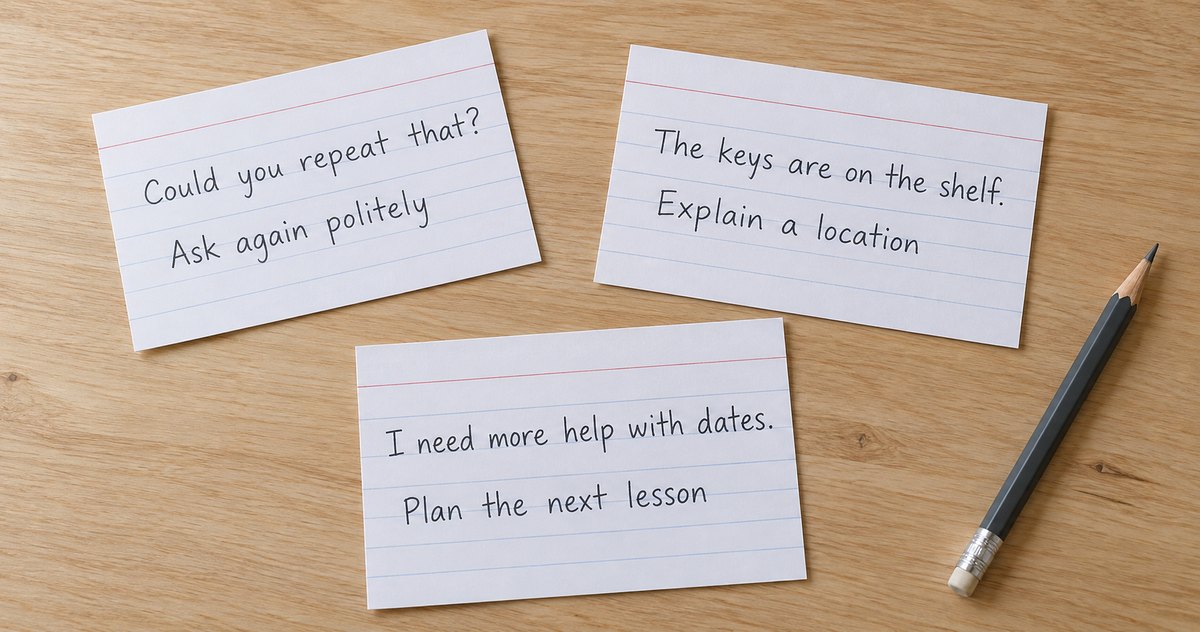
A lively lesson can finish with everyone nodding while you're still unsure who can use the language. An exit ticket is a short response at the end of class that helps you decide what to revisit. I'd keep it tied to one lesson goal and small enough that every adult learner can respond.
Start with the decision you need to make
Suppose the goal is asking someone to repeat information politely. You need evidence of a usable request, not just a confidence rating. Ask learners to write or record one response to a new situation. A separate comment about what felt difficult can help, but it doesn't replace evidence of the language.
Three prompts you can adapt
A2: ask again politely
Learner card: You didn't hear a colleague's arrival time. Write one sentence asking them to repeat it.
Teacher note: Could you repeat the arrival time, please? is one suitable response; other natural requests also work. Look for an understandable request directed at the missing information. This checks a clarification goal.
A2-B1: explain a location
Learner card: Your keys are on the shelf beside the door. Write a message so your flatmate can find them.
Teacher note: The keys are on the shelf beside the door communicates the location. Accept wording such as You'll find them on the shelf by the door. Note whether a misplaced preposition changes the meaning. This checks location language.
B1-B2: make a concern actionable
Learner card: A team wants to hold a meeting at 8 a.m., but two colleagues start work at 9. Suggest another time and explain why.
Teacher note: Could we meet at 9? That would allow everyone to attend is one possibility. Look for a clear alternative and a relevant reason. This checks workplace suggestion language, not agreement with one exact sentence.
Use the prompt that matches the lesson; you don't need all three. These fictional situations and reference responses are original materials. A brief ticket shows performance on that task, not a learner's overall level or lasting mastery.
Keep the response individual and accessible
Collect a response from each learner before partners compare. Offer large-print cards or an accessible text version. For a speaking goal, a brief private audio response may fit better than writing. Online, use a private message or form so learners don't simply copy the first public answer.
For A2, simplify the situation or offer a starter such as Could you...?, recording that support was provided. For B2, add a constraint or ask for a reason. When responses use different support or modes, take those differences into account before comparing them.
Use the evidence at the next lesson
Sort the responses by what would help next: ready to reuse, a specific error to revisit, or a meaning that's still unclear. Check unclear answers with the learner. Give one useful comment, such as Your request is clear. Add the detail you need repeated. Then start the next class with a short example addressing the common difficulty.
A suggested 30-minute sequence
- 0-5 minutes: introduce one everyday situation and model the target language.
- 5-12 minutes: compare two original examples and clarify their meaning.
- 12-23 minutes: use a short pair task with changed details; monitor the target language.
- 23-28 minutes: give focused feedback and allow another attempt.
- 28-30 minutes: collect one individual exit response and an optional support request.
Build the ticket into your adult ESL lesson plan. Use concept checking during explanations and pair work for the longer speaking task.
Sources and editorial notes
Checked on 13 October 2026: American English: collecting and using assessment data and American English: exit tickets. These support brief formative checks and using responses to plan follow-up. The adult scenarios, adaptations, feedback wording and timed sequence are Poly-Puff suggestions; they have not been evaluated as a classroom intervention.
Put useful English into practice
Explore Word Chunks and keep useful language in your learning routine.